At around 10 a.m. on September 4, on the diverted section of the newly built Agate River Bridge in Anfu Temple Town, Zhijiang City, Yichang City, heavy trucks fully loaded with goods and small cars were passing back and forth in an orderly manner. Unlike the traffic cones, water-filled barriers and other isolation facilities usually placed on expressways, a row of white prefabricated guardrails was set up on site, looking safer and more aesthetically pleasing.
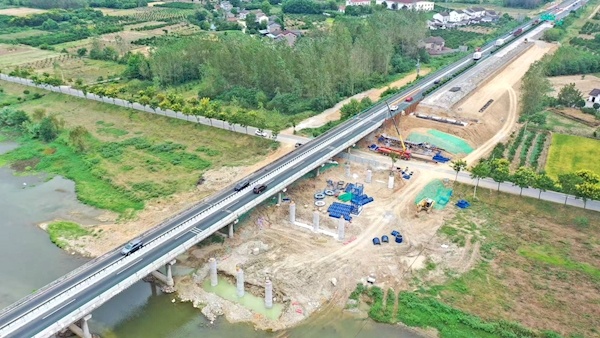
The 10th bid section of the Wuhan-Yichang reconstruction and expansion project, undertaken by PowerChina Roadbridge Group, is 30.466 kilometers long and passes through Zhijiang City, Yiling District, Xiaoting District and Wujiagang District, intersecting with 2 expressways, 2 railways, more than 10 local roads and 4 high-voltage lines along the way.
Zhang Rui, safety director of the 10th bid section of the Wuhan-Yichang reconstruction and expansion project of PowerChina Roadbridge Group, introduced that since the project involves expanding 4 lanes to 8 lanes and construction is carried out while traffic continues, with heavy traffic volume and many heavy-duty vehicles, and requires multiple switches to the single-carriageway two-way traffic mode, safety risks are prominent. Traditional water-filled barriers and traffic cones have weak impact resistance; if hit by heavy-duty vehicles, they can easily be breached, and vehicles can very easily rush into the work area.
For this reason, in January this year, the project department built and put into use a New Jersey barrier processing plant covering an area of 44 mu in Anfu Temple Town, Zhijiang City, about 1 kilometer to the left of the main line at K1159+300, specializing in the production of prefabricated concrete barriers that serve both temporary traffic maintenance and permanent engineering functions.
When a Jimu News reporter entered the plant, they saw that a standardized prefabricated production line had been built. The production line uses a long linear steel rail channel to connect functional areas such as steel bar positioning, mold placement, pouring and vibration, and spray curing, achieving "assembly-line-style" operation.
Cui Hui, head of the processing plant, introduced that the prefabricated barriers are composed of concrete, steel bars and embedded connectors, with a daily output of about 100 pieces. Each piece weighs about 1 ton and is cured for 7 days, taking about 10 days from production to use. Compared with traditional processes, dimensional accuracy is controlled within ±2 mm, and the template turnover rate is increased by 40%, greatly shortening the construction period.
In the finished prefabricated barrier area, the Jimu News reporter saw that each barrier is 4 meters long and 1.1 meters high, with a uniform and smooth appearance surface free of air holes, and it is difficult to push with both hands. "Prefabricated concrete barriers have high self-weight, and the blocks are connected into a whole through channel steel bolts, so their ability to resist vehicle impact is greatly improved compared with water-filled barriers and traffic cones," said Mao Baodi, chief engineer of the project.
"In May this year, we took the lead across the entire Wuhan-Yichang reconstruction and expansion line in completing half-width closure, traffic diversion and half-width opening to traffic, mainly involving 2.5 kilometers of pavement," said Wang Yong, project manager of PowerChina Roadbridge Group for the project. The New Jersey barrier processing plant played a major role in this.
Building a dedicated plant to produce prefabricated barriers costs more than traditional water-filled barriers and traffic cones. Is it worth it? In response to a Jimu News question, the project manager said that safe production is the top priority. Using prefabricated barriers not only ensures safety to a greater extent but also saves construction time. Some prefabricated barriers are used in the early stage as temporary isolation blocks for traffic diversion and can be used at the joints of new and old subgrades and in the emergency lanes of the old road, while those used in the central median of interchanges, hubs and service areas (Zhijiang West Service Area) will serve as permanent anti-collision guardrails, realizing the turnover and reuse of components and reducing energy consumption and waste.
The same concept of green construction is reflected in the construction of the Agate River Bridge, an important node along the line. Mao Baodi said that for areas such as the provincial wetland park spanning the Agate River, the project strictly implements water pollution prevention and control, dust control and noise isolation measures. Lime soil slaking is carried out in a centralized manner inside enclosed sheds, and road-mixing operations are equipped with sprinkling for dust suppression; pile foundation mud is centrally treated using mobile tanks to prevent oil pollution leakage and minimize the impact of construction on the environment along the line.
Chutian Metropolis Daily
First Pile Foundation Tie Beam Concrete Pour Completed for Mayashan Grand Bridge on Bianmen Expressway
下一篇Pile Driving for Power Transmission Towers in Overseas Deserts! XCMG XR240E Handles Challenging Rotary Drilling Conditions!

2026-09-28 1157 0

2026-09-24 10586 0

2026-09-23 10714 0

2026-09-22 10808 0

Lize City Air Terminal Underground Main Structure Nearing Completion: Maximum Transfer Walk Under 4 Minutes After Operation

Anti-seepage Curtain for Main Lock Pit of CSCEC Port Shenqiu Double-Line Lock Project Completed on Schedule

All Pile Foundations Completed on Quanzhou Baiqi Channel

Hainan Upgrades Housing and Municipal Infrastructure

First Foundation Concrete Pour Successfully Completed for Zambia Kafue West–Muzuma 330kV Transmission Line EPC Project
Hot News

评论 (0)