On January 16, the critical node of the Xinmeng River Extension and Dredging Project in Jiangsu Province—the crossing of the Beijing-Shanghai High-Speed Railway—was successfully completed. China Railway 24th Bureau took 959 days to set a national precedent for large-scale earthwork excavation under an operational high-speed railway bridge. The Xinmeng River Extension and Dredging Project is one of the 172 major water conservation and water supply projects of the state and an important project for comprehensive water environment management in the Taihu Lake Basin.
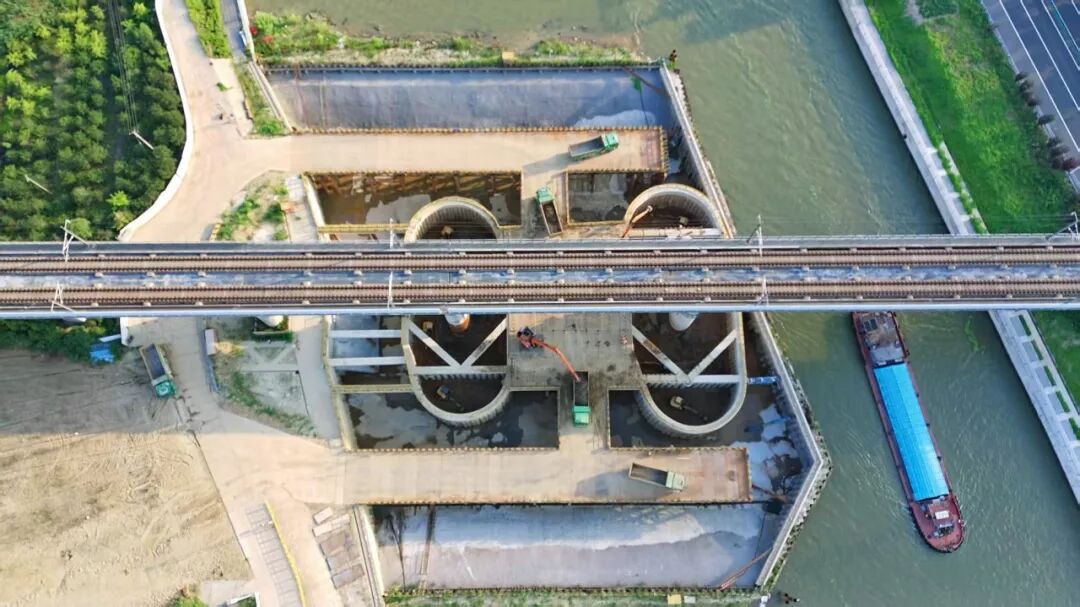
The Beijing-Shanghai High-Speed Railway crossing project is the throat of the entire Xinmeng River Extension and Dredging Project. Overhead, a train roars past every 4 minutes on average; in between, the minimum clearance between the foundation pit and the lower part of the bridge is only 11 meters, making it difficult for large machinery to operate; below, earthwork excavation of 98 meters long, 76 meters wide, and 11.4 meters deep must be completed, with a volume close to that of 40 standard swimming pools.
Because the Xinmeng River channel is widened from 44 meters to 136.4 meters, the bridge piers originally located on the river embankment will become in-water piers. This requires a series of processes including earthwork unloading for the foundation pit of the existing railway bridge, concrete bottom sealing, removal of retaining structures, and riverbed foundation reinforcement. There is currently no precedent for similar construction in China.
The biggest difficulty lies in how to reduce the impact of line disturbance and control bridge pier deformation within limits. If bridge pier deformation exceeds the limit of 2 millimeters, the line must be immediately closed. Once the Beijing-Shanghai High-Speed Railway, the main artery of the national high-speed rail network, is suspended, the social impact and economic losses would be immeasurable. "Built by the water," one must "control the water first." In response to the complex conditions of the site surrounded by water on three sides, the project technical team conducted in-depth research on hydrogeological characteristics and repeatedly optimized the support scheme based on the characteristics of the stratum structure. A total of 1,534 bored piles, secant piles, and steel sheet piles were precisely arranged and tightly interlocked to form a closed and stable foundation pit, while building a watertight "wall" for the high-speed railway bridge piers.
Outside the "wall," the work area was divided into four stages and 11 layers, and further divided into 24 zones centered on the high-speed railway line, with excavation boundaries, depths, and process arrangements all precisely controlled; inside the "wall," precision control requirements were even stricter, and the work area was divided into three stages and 9 layers. Manual excavation was used within 50 centimeters around the bridge piers to minimize disturbance to the pier foundations from mechanical operations. To achieve the goal of "keeping it under control," data monitoring ran through the entire process. Symmetrical excavation was carried out on both sides of the railway. After each layer was excavated, it was left standing for seven to ten days until the soil stress was fully released and stable rebound occurred, and only after joint assessment by research institutes and railway experts did the next process begin, avoiding sudden load changes and imbalance caused by rushing work.
The Xinmeng River Project connects to the Yangtze River in the north and the Taihu Lake in the south. It is a backbone water diversion and drainage project in the Taihu Lake Basin approved by the State Council, consisting of river channel dredging, embankment construction, and water conservancy hubs. With the core function of diverting water from the Yangtze River to Taihu Lake, it has multiple benefits such as flood control and drainage, water resource allocation, water environment improvement, and navigation, and is designed according to the standard of a once-in-100-year basin flood.
Relying on the brand advantage and professional expertise accumulated over years of deep cultivation in the field of construction adjacent to existing railway lines, Shanghai Company of China Railway 24th Bureau won the Xinmeng River Extension and Dredging Project crossing the Beijing-Shanghai High-Speed Railway, taking on the toughest "hard bone" of the entire line.
Shanghai Company gathered internal advantageous resources and formed an elite team covering technical, safety, digital, and other fields. Relying on the company's "Operational Line Construction Innovation Studio," the team focused on key and difficult points in project management and made every effort to increase technical research and process optimization.
To control bridge deformation, daily monitoring is key. The project technical team established a dynamic intelligent monitoring and feedback control system and simultaneously introduced three professional monitoring agencies to conduct 24-hour monitoring of settlement and displacement changes of bridge piers, beam bottoms, and track alignment.
The project department fully implemented the "one scheme, one animation" model. They innovatively used "BIM + drone real-scene modeling" technology to produce more than 10 construction animations for deep foundation pits, steel truss erection, and other works, which are widely used in technical disclosure, scheme exchange, scheme review, and personnel training, playing an important role in improving work efficiency and cultivating professional talents.
"It is both a water conservancy project and construction adjacent to an existing line. Overcoming this 'hard bone' has contributed immensely to enhancing our specialized capabilities," said the technical director of Shanghai Company. He stated that they will comprehensively summarize the technological innovation work of the Xinmeng River Project and continuously increase the "gold content" of the operational line construction brand.
The Xinmeng River Extension and Dredging Project is not only a water conservancy project for comprehensive water environment management in the Taihu Lake Basin but also a railway-related project involving multiple important railway lines such as the Beijing-Shanghai High-Speed Railway and the Beijing-Shanghai Railway. The construction unit belongs to the water conservancy system, the agent construction unit is deeply engaged in the railway field, safety supervision falls under water conservancy, and quality supervision falls under housing and urban-rural development. Technical standards and regulatory details in different fields are vastly different. Which to use as the benchmark, which contents must be unified, which can be flexibly connected, and how to communicate efficiently have become core issues that all parties urgently need to explore and solve to collaboratively advance project construction.
To achieve data interconnection and synchronized communication, the project team integrated the China Railway Construction Intelligent Control Platform with the Railway Shanghai Bureau's Digital Intelligence Platform, the Engineering Equipment System, and other platforms, enabling real-time synchronization of on-site data among all units, with all management actions traceable online and closed-loop. On the basis of real-time online data sharing, all parties also held daily meetings to efficiently sort out differences and finalize plans. Problems that originally required more effort to coordinate and solve were often "closed" in just half an hour or less under this new mechanism. Before each "exam," the project team, together with water conservancy and railway departments, conducted on-site surveys to accurately calculate the optimal time window for navigation interruption and speed restriction, and scientifically formulated special plans for traffic guidance and safety protection. During operations, dedicated personnel were assigned to "invigilate" on site, closely monitoring construction processes and monitoring data changes, and implementing full-process, all-round dynamic control to ensure that all measures were implemented effectively. After the operation was completed, a "review" was immediately organized to continuously optimize subsequent processes. The parties that originally "worked separately" gradually became comrades "pulling in the same direction."
The successful completion of the Xinmeng River Project is not only a success in technological innovation but also a breakthrough in management innovation. The project department will comprehensively summarize the practical experience of collaborative win-win among all parties for reference by more similar projects. The river flows mightily, and high-speed trains speed by. The north-south artery, the Beijing-Shanghai High-Speed Railway, soars over the Xinmeng River. The road of "crossing" has become wider and more stable, and the growth path of China Railway 24th Bureau's brand in construction adjacent to existing lines has also become wider and broader.
Foundation Pit of Key Section of Jiangnan Connecting Line of Nanjing Jianning Road Yangtze River Tunnel Successfully Sealed at Bottom
下一篇Underground Diaphragm Wall Construction Completed for the Launch Shaft of Section 1 of the Hefei G4001 Connecting Line Project

2026-09-28 1157 0

2026-09-24 10586 0

2026-09-23 10714 0

2026-09-22 10808 0

Lize City Air Terminal Underground Main Structure Nearing Completion: Maximum Transfer Walk Under 4 Minutes After Operation

Anti-seepage Curtain for Main Lock Pit of CSCEC Port Shenqiu Double-Line Lock Project Completed on Schedule

All Pile Foundations Completed on Quanzhou Baiqi Channel

Hainan Upgrades Housing and Municipal Infrastructure

First Foundation Concrete Pour Successfully Completed for Zambia Kafue West–Muzuma 330kV Transmission Line EPC Project
Hot News

评论 (0)