According to the assessment based on the "New Round of Rural Road Improvement Action Plan," China's rural road development has officially entered a new stage of "equal emphasis on precise incremental construction and quality improvement and efficiency enhancement of existing assets."
In the current rural road quality improvement scenario, given that asphalt pavement construction requires no curing period, has little impact on existing traffic, can achieve rapid maintenance, and offers advantages in terms of driving comfort, many regions tend to adopt the "white-to-black" (concrete-to-asphalt) solution.
However, traditional cement concrete roads, with advantages such as high strength, low initial construction cost, and low routine maintenance workload, remain applicable in rural road quality improvement for scenarios such as heavily loaded and high-frequency traffic sections, remote and economically weak rural sections, and terminal sections of road network extensions.
At this point, the meaning of quality improvement lies in how to pave high-quality cement concrete surface layers in such environments, fully demonstrating the long-life advantages of cement pavement. This again points to innovation in construction technology—a shift from traditional manual formwork to mechanized slipform construction.
The Wirtgen SP 25(i), as a compact and flexible multifunctional slipform paver, can both pave cement concrete slabs in the forward direction and side-pave auxiliary facilities such as drainage ditches, curbs, crash barriers, and other cement concrete structures also needed for rural roads.
Existing successful construction cases show that compared with traditional manual methods, this mechanized construction process is more continuous, more consistent in quality, and more efficient, and has great potential in rural road quality improvement.
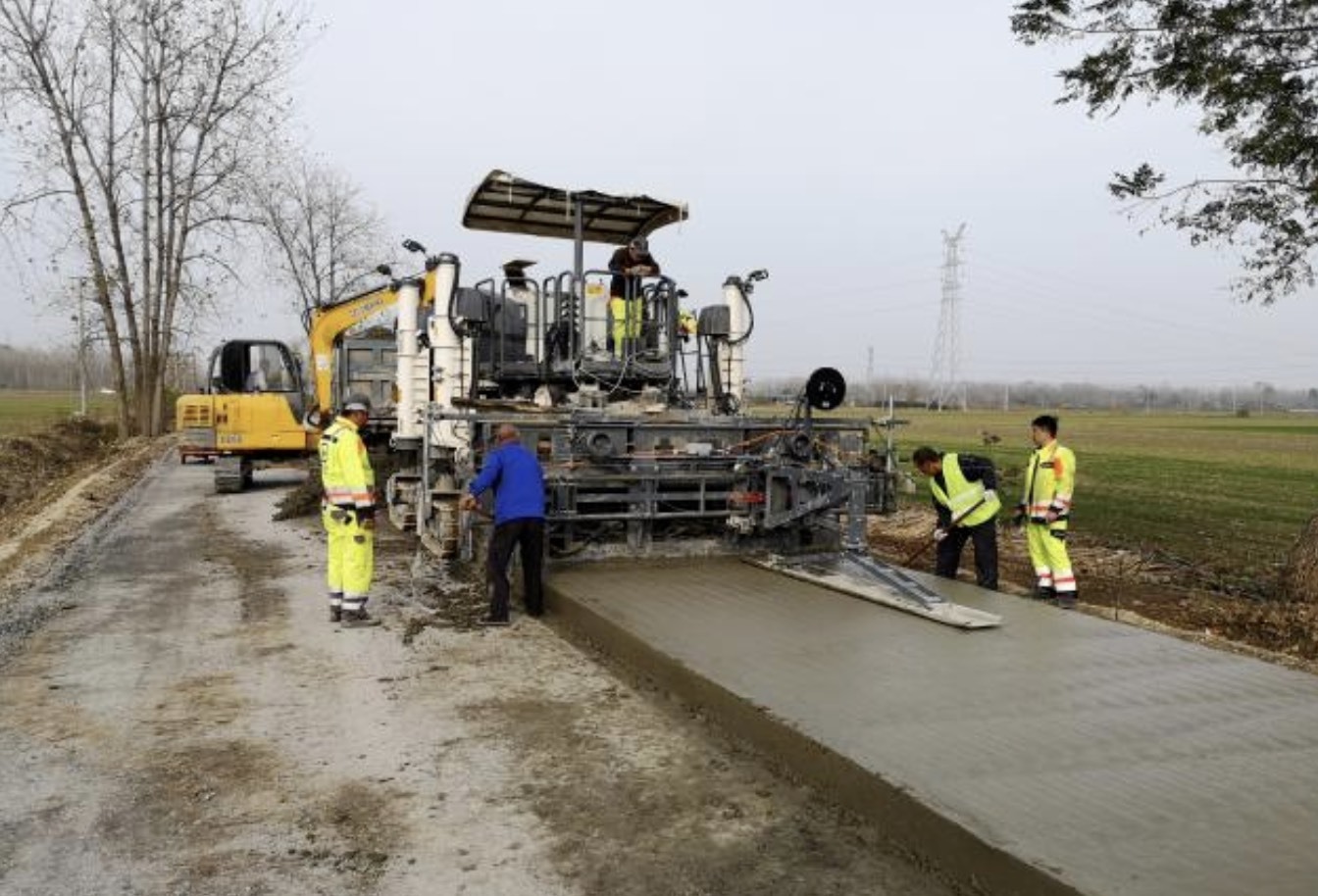
Wirtgen slipform paver paving half-width cement concrete pavement, one-pass forming, stable and efficient
Project Overview
The Anhui Taihe Rural Road Upgrade and Reconstruction Project is an important infrastructure project for Taihe County in implementing the rural revitalization strategy. The project plans to implement approximately 104 km of rural road quality improvement and reconstruction works, covering 16 townships across the county, and simultaneously implement 180 km of maintenance works, radiating to 31 townships. The construction content covers pavement widening and structural strengthening to Class III and Class IV highway standards.
The original pavement width was only 3.5 m–5 m; after reconstruction, it is uniformly widened to 7 m–7.5 m, with structure types of concrete and asphalt concrete pavement. The total project duration is 180 calendar days, with a tight schedule and heavy tasks, placing high demands on the efficiency and adaptability of construction equipment.
To solve problems such as concrete surface scaling and damage on the original pavement caused by freeze-thaw in winter, the contractor selected the Wirtgen SP 25(i) slipform paver, adopting a one-pass paving and forming process to effectively improve road durability and smoothness.

One machine, multiple functions, widening the road to rural prosperity
Although compact in body, the Wirtgen SP 25(i) harbors strong power. Its engine has a rated power of up to 118 kW and features dual-mode construction capability: in forward paving mode, it can pave cement concrete pavement slabs 1.0 m–3.75 m wide and up to 400 mm thick; it can also side-pave various concrete structures such as water channels, crash barriers, curbs, V-shaped gutters, and sidewalks.
In the Taihe project, the SP 25(i) is mainly responsible for paving the widened concrete pavement, adopting the slipform one-pass forming process with a paving width of 3.5 m. The machine is equipped with 10 high-frequency vibrators that vibrate, compact, and de-air the cement concrete, which is then extruded and formed within the mold.
Afterward, the heavy-duty smoothing beam at the rear of the machine, driven by a hydraulically driven eccentric mechanism in reciprocating motion, kneads and levels the concrete surface; the super smoother mounted on the extension arm further repairs and treats the concrete surface, creating a smooth and level surface effect.
As a capable tool for rural roads, the SP 25(i) is not only suitable for cement pavement applications but also supports modular expansion with various attachments, handling side-paving of highway tunnel cable trenches and oversized water channels with ease, truly achieving "one machine, multiple uses," which is highly suited to the characteristics of rural road projects with complex types and scattered work areas.
Efficient and stable, saving labor
During construction, the SP 25(i) integrates multiple processes including material distribution, vibration, compaction, smoothing, and finishing, requiring only 1–2 operators to complete full-line control. In the Taihe project, the SP 25(i) can complete an average of 300–500 m of concrete paving per day, with a construction speed of 1.5–2.5 m/min, effectively ensuring schedule progress.
Compared with traditional processes requiring more than a dozen workers operating simultaneously, the SP 25(i) significantly reduces labor costs and labor intensity. At the same time, mechanized construction ensures continuous and stable paving quality, guaranteeing the strength and high smoothness of the formed concrete pavement, thereby safeguarding pavement service life and comfort.
Excellent forming quality, long-term disease prevention
In response to the challenges of low winter temperatures in the Taihe area and the susceptibility of concrete to freeze-thaw scaling, the SP 25(i) performed excellently during construction. High-frequency electric vibrators are used to fully vibrate the concrete, expel internal air bubbles, and improve compactness; then, through the action of the smoothing beam and super smoother, a uniform and dense surface structure is formed.
The one-pass forming process avoids the risk of interlayer delamination caused by multi-layer construction, resulting in high overall slab strength and good durability, fundamentally enhancing the road's resistance to freeze-thaw and spalling.
The smoothness deviation of the concrete pavement after construction is controlled within the high-standard range permitted by specifications, with uniform surface texture and roughness meeting design requirements, significantly improving vehicle driving stability and safety, and also providing an excellent base layer for possible subsequent asphalt overlays.
Breakthrough Directions for Future Factories in Construction Machinery: Intelligent, Flexible, and Green
下一篇[16th Pile Foundation Academic Conference] The Venue Was Electric! Three Decades of Accumulation, Industry Leaders Gathered, First-Day Highlights at a Glance!

2026-09-28 1157 0

2026-09-24 10586 0

2026-09-23 10714 0

2026-09-22 10808 0

Lize City Air Terminal Underground Main Structure Nearing Completion: Maximum Transfer Walk Under 4 Minutes After Operation

Anti-seepage Curtain for Main Lock Pit of CSCEC Port Shenqiu Double-Line Lock Project Completed on Schedule

All Pile Foundations Completed on Quanzhou Baiqi Channel

Hainan Upgrades Housing and Municipal Infrastructure

First Foundation Concrete Pour Successfully Completed for Zambia Kafue West–Muzuma 330kV Transmission Line EPC Project
Hot News

评论 (0)