
On November 25, 2025, Workers' Daily launched its "Intelligentization in Enterprises" series of reports, providing a panoramic decoding of enterprises' intelligent transformation practices, tracking the new achievements of traditional manufacturing in solving production pain points through intelligent transformation and digital upgrading, focusing on the new vitality brought by the upgrading of emerging industries, and paying attention to new trends in the intelligent exploration of future industries. The first report is titled "Who Is the Star of the Future Factory?", taking Zoomlion as a typical case to showcase its high-quality development achievements that lead the industry.
In the construction machinery industry, the smart factory has always been a hot topic. Today, as the technological revolution intensifies, the global competitive landscape is being profoundly reshaped. If construction machinery enterprises want to take the initiative in the future market, they must make achievements in scientific and technological innovation and industrial innovation. As the starting point for advancing new industrialization, the smart factory has naturally become the focus of everyone's attention.
Direction for Breaking Through: Intelligentization, Flexibility, and Green Development
If construction machinery enterprises want to make breakthroughs in smart factories, they must break through in the three major directions of intelligentization, flexibility, and green development. Only in this way can smart factories inject a steady stream of momentum into enterprise development.
1 Intelligentization Solves the Efficiency Problem
Whether it was the first industrial revolution or the second industrial revolution, the core was solving the problem of production efficiency, and what intelligentization solves is the efficiency challenge. Through intelligent technologies such as AI and the industrial internet, as well as tools such as intelligent process management systems and digital twins, the production efficiency of smart factories has achieved a qualitative improvement compared with traditional factories.
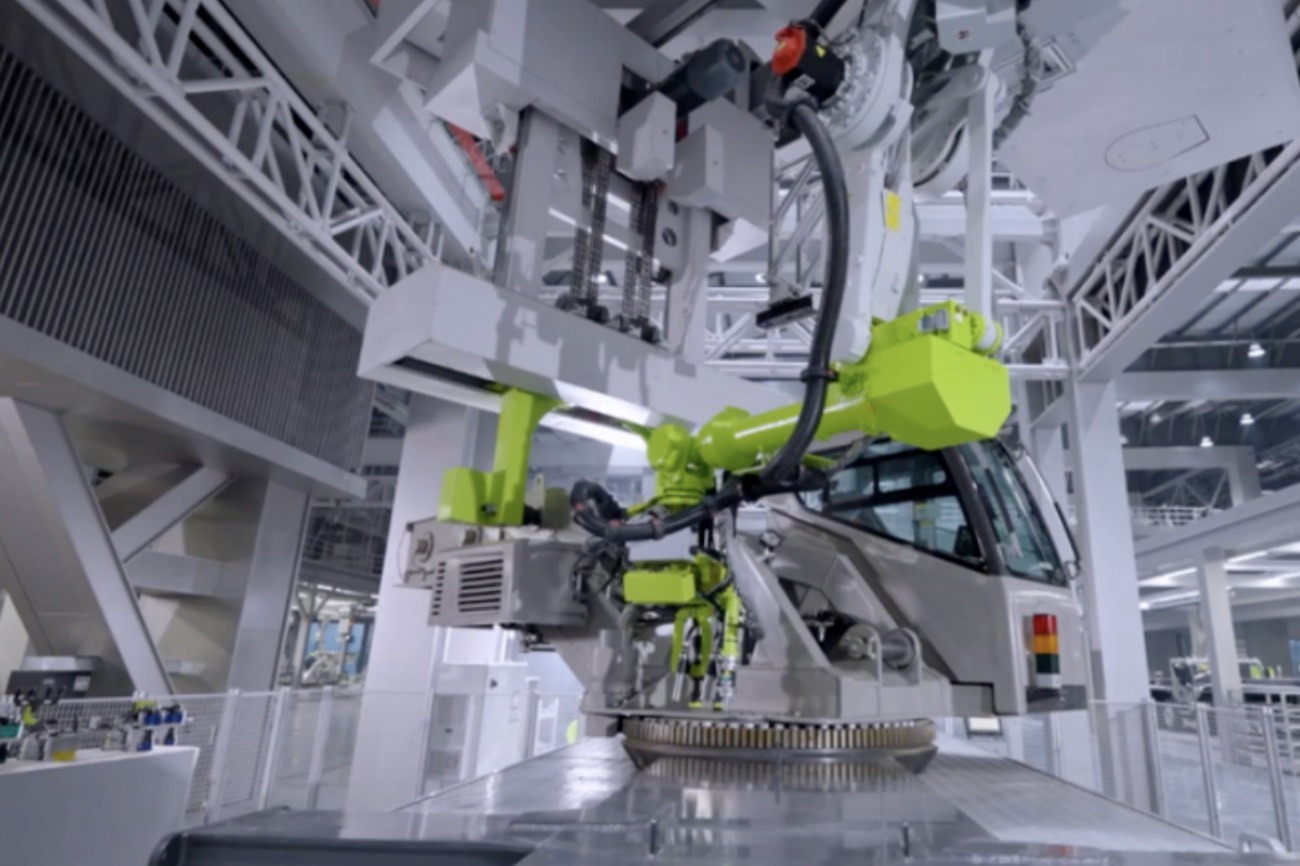
In the assembly workshop of the hoisting machinery park at Zoomlion Smart Industrial City, an aerial conveying system and nearly 300 AMR autonomous planning robots on the ground form an automated transportation system, which not only saves space but also improves logistics distribution efficiency and workshop assembly efficiency. At the same time, the workshop has 36 production line central control systems and 22 information systems woven into a huge information network. The central control screen displays the status of workpieces and processing parameters in real time, and can even trace back to the process data at the source of the product, achieving end-to-end connectivity from production to supply and sales. Through the combination of this visible wisdom and invisible wisdom, production efficiency has increased by more than 30%. At present, the park's production line can roll off one crane every 18 minutes, with an annual capacity of about 15,000 units.

Intelligentization is not limited to a single production link, but can play a role throughout the entire production process. In LiuGong's excavator smart factory, across all steps from material cutting and forming to fit-up welding, machining, coating, assembly, and debugging, through intelligent manufacturing upgrading, its overall capacity has increased by 45%, the order response cycle has been shortened by 45%, the automation rate has increased by 65%, and production efficiency has increased by 25%, continuously achieving lean and intelligent production and realizing an annual capacity of 20,000 medium and large excavators (including electric excavators and their supporting structural parts).
For the construction machinery industry, intelligentization is the "efficiency engine" of the future factory.
2 Flexibility Solves the Challenge of Many Varieties and Small Batches
In the construction machinery industry, because what is produced consists of relatively large structural parts, the versatility of structural parts is relatively ordinary compared with the automotive industry. In addition, the machine models produced in the construction machinery industry are not like those in the automotive industry, which can produce a certain model in large batches; instead, they have the characteristic of "small batches and multiple varieties." Under such circumstances, flexible production has become the key to breaking through. It enables enterprises to respond quickly to market changes, achieve efficient and flexible production, and meet customers' personalized needs.
Flexible production refers to the ability of a manufacturing system to respond quickly to changes in the internal and external environment, specifically manifested in the factory's ability to achieve rapid conversion and collaborative production among multiple products, multiple processes, multiple forms, and multiple units.

Through advanced flexible manufacturing processes, Zoomlion has helped enterprises solve troubles such as multiple varieties, small batches, many parts, and large demand fluctuations. For example, in Zoomlion's mixer truck smart factory, through the flexible configuration of the production line, the same production line can produce mixer trucks with different configurations and colors requested by multiple customers within the same shift. It can achieve mixed-line production of more than 200 types of mixer trucks, significantly reducing the inventory of self-made and purchased parts, increasing the assembly automation rate to 73.3%, increasing the logistics automation rate to 90%, and achieving 100% traceability of process parameters and key components.
Cummins has also done very well in better meeting customer needs through flexible manufacturing. The flexible manufacturing unit of the Chongqing Cummins plant has achieved local manufacturing of the full range of 14-60L high-horsepower engines. The flexible production line has an annual capacity of 23,000 units, and the delivery cycle has been shortened to 18 days, enabling it to quickly meet the differentiated needs of global customers and provide customers with more efficient and considerate service.
3 Green Development Solves Environmental Protection Problems
Under the "dual carbon" goals, the integration of green technological innovation and industrial green transformation is becoming a new growth pole in the industrial field. This is also true for smart factories. Green manufacturing processes can not only reduce the impact on the environment but also further lower enterprises' production costs.

The XCMG heavy-duty coating workshop is a good example. In the automatic spraying room, the workshop's extending arm uses two 7-axis spraying robots for spraying, and the coating utilization rate has increased from 51% to more than 65%. Through the application of these green manufacturing processes, XCMG has achieved low-carbon innovation in the production process, improved resource utilization efficiency, and reduced environmental pollution.

Zoomlion's mixer truck intelligent manufacturing industrial park also empowers green manufacturing with new processes and new technologies. For example, to reduce the use of harmful substances, water-based paint is used instead of oil-based paint, and lead-free welding wire is used instead of leaded welding wire; an automatic powder spraying production line is set up in the joint workshop, adopting electrostatic powder spraying, which can automatically recover powder coatings, with a recovery efficiency of 99%, and so on.
In addition to green production models, the circular economy model is also an important path for the construction machinery industry to achieve sustainable development. By building a closed-loop industrial chain of "manufacturing, use, and remanufacturing," enterprises can make full use of resources and reduce the generation of waste.

In March 2025, at the Construction Machinery Remanufacturing and Maintenance Base in the Changsha area of the China (Hunan) Pilot Free Trade Zone, 566 pieces of equipment were dispatched in a concentrated manner and sold to dozens of countries and regions such as Southeast Asia, Africa, Central Asia, and the Middle East. These pieces of equipment came from enterprises such as Zoomlion, Sany Group, and Sunward, covering more than 10 categories including excavators, pump trucks, and rotary drilling rigs. The remanufacturing circular economy model not only increases enterprise sales, saves resources, and lowers production costs, but also reduces damage to the environment, making a positive contribution to building a sustainable industrial ecosystem.
In this era full of change, intelligentization, flexibility, and green development are reshaping the development trajectory of the construction machinery industry. If enterprises want to build advanced future factories, only by making coordinated efforts in these three major directions can they jointly outline a brand-new picture of the future factory of construction machinery.
A Model of Sino-German Cooperation, Moving Forward Together Toward a New Journey | The 30th Anniversary of ZF Liuzhou and the Launch Ceremony of Its New Journey Successfully Held
下一篇Wirtgen Slipform Paving Technology Helps Rural Roads Take on a New Look

2026-09-28 1157 0

2026-09-24 10586 0

2026-09-23 10714 0

2026-09-22 10808 0

Lize City Air Terminal Underground Main Structure Nearing Completion: Maximum Transfer Walk Under 4 Minutes After Operation

Anti-seepage Curtain for Main Lock Pit of CSCEC Port Shenqiu Double-Line Lock Project Completed on Schedule

All Pile Foundations Completed on Quanzhou Baiqi Channel

Hainan Upgrades Housing and Municipal Infrastructure

First Foundation Concrete Pour Successfully Completed for Zambia Kafue West–Muzuma 330kV Transmission Line EPC Project
Hot News

评论 (0)