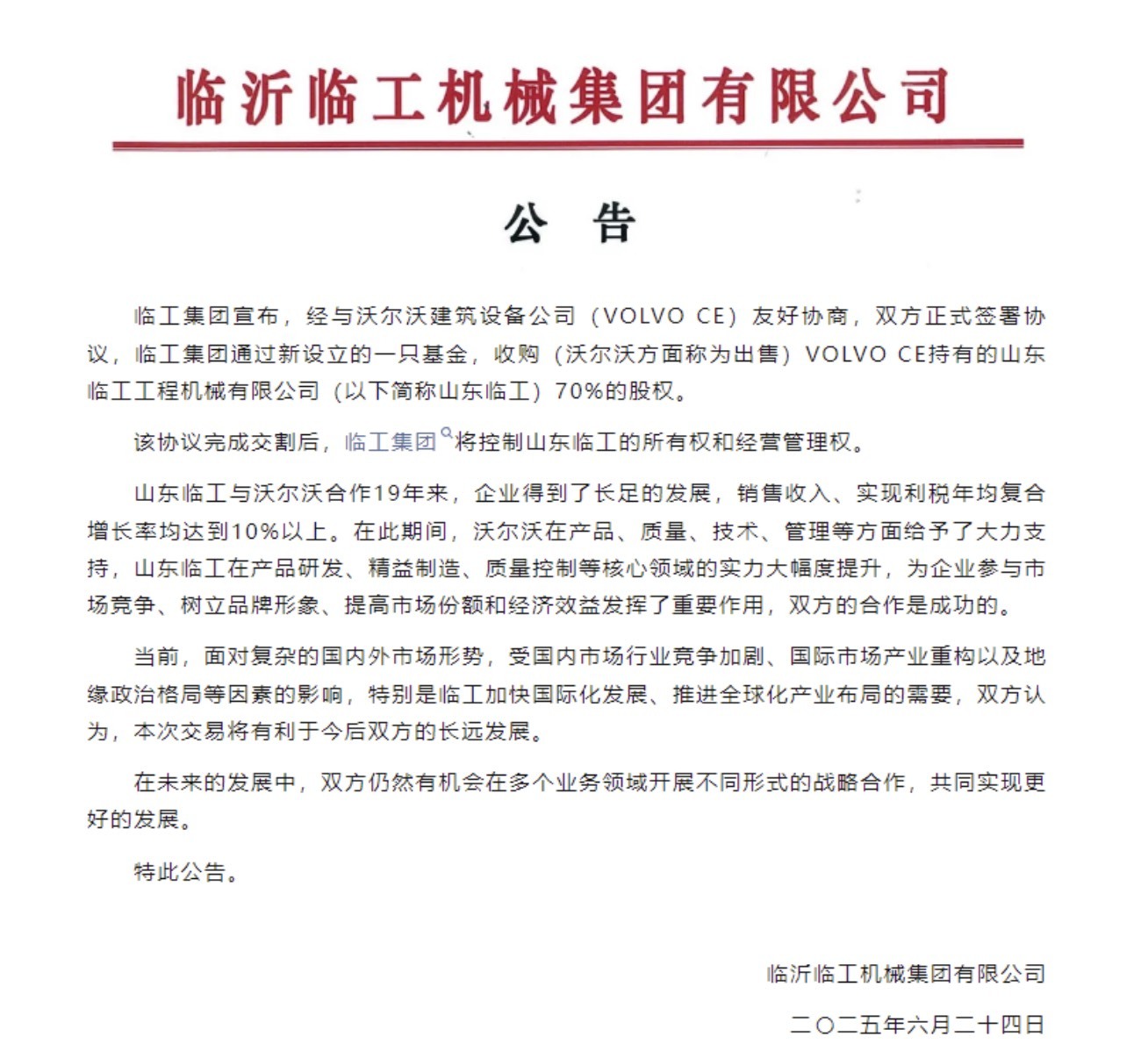
Recently, a major piece of news stirred China's construction machinery industry—Lingong Group and Volvo Construction Equipment (VOLVO CE) officially signed an equity acquisition agreement, acquiring through a newly established fund the 70% stake in Shandong Lingong held by the latter. This means that, after 19 years of foreign control since 2007, Shandong Lingong will return completely to the embrace of domestic capital, with its ownership and operational management rights reverting to Lingong Group.
This "breakup" spanning nearly two decades is not only a change in a company's equity structure, but also reflects the shift in the industry landscape of China's construction machinery sector from "trading market for technology" to "breaking through through independent development."
01 The Origins of Shandong Lingong and VOLVO CE
Shandong Lingong was founded in 1972, formerly the Shandong Linyi Machinery Factory. Its main products include loaders, excavators, road machinery, and core key components, among other series of construction machinery products.
VOLVO CE is a core member of the Volvo Group, founded in 1832, and ranked 8th on the 2025 Global Top 50 Construction Equipment Manufacturers list. Its main products include excavators, wheel loaders, articulated haulers, and rigid dump trucks. VOLVO CE entered the Chinese market in 2002 and officially relocated its Asian headquarters from Singapore to Shanghai, China, in 2020.
At the time, Volvo Construction Equipment, as a globally renowned construction equipment manufacturer, had been committed to expanding its market share in the construction equipment field worldwide, while Shandong Lingong already had a certain influence in China's construction machinery industry. Thus, on September 27, 2006, Shandong Lingong and VOLVO CE officially signed a strategic cooperation agreement, embarking on the path of international development.
In 2007, VOLVO CE acquired a 70% stake in Shandong Lingong for a total transaction value of 327.5 million yuan, becoming its controlling shareholder. After the acquisition, Volvo and Shandong Lingong implemented a dual-brand strategy, retaining the "Shandong Lingong" brand while leveraging Volvo's technology and management experience to enhance Shandong Lingong's product competitiveness.
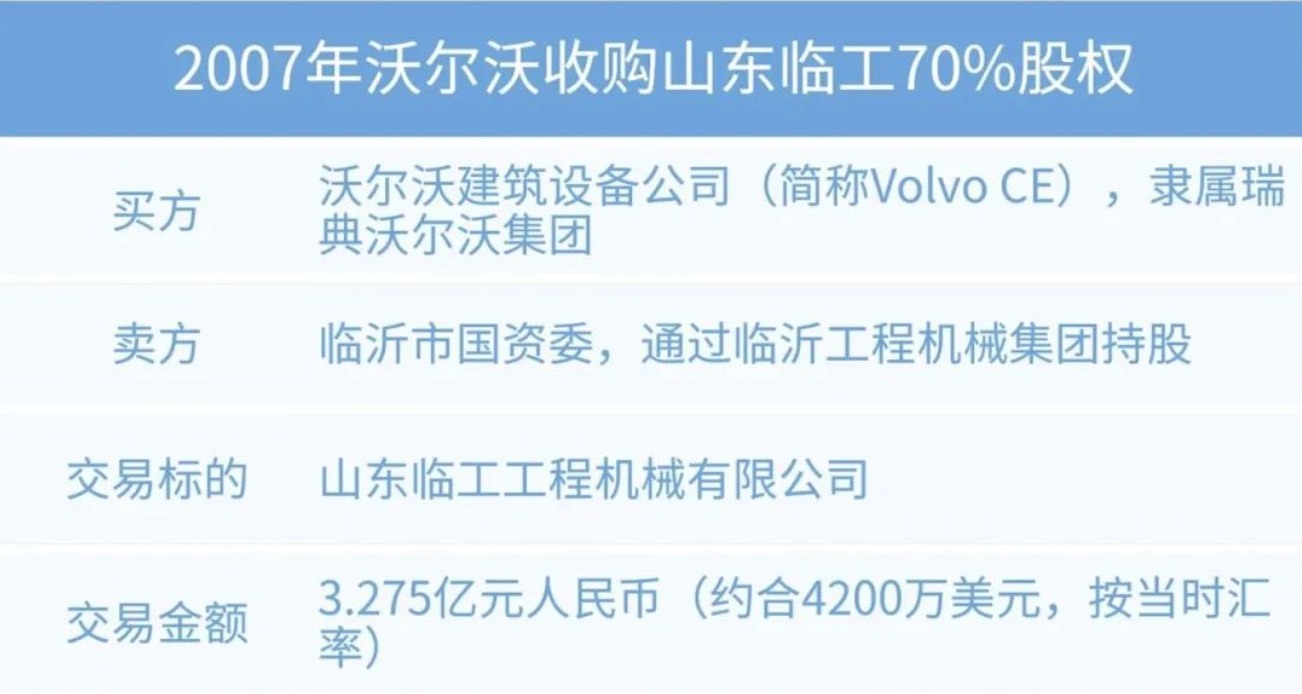
Data shows that this foreign acquisition was a win-win. At the time, China was Volvo's largest and most important market, and Volvo well understood the importance of designing and manufacturing products that meet local needs in the local market, thus obtaining a "bridgehead" into China's construction machinery market at a relatively low cost.
Shandong Lingong, in turn, transformed from a local state-owned enterprise into an internationalized company, with comprehensive upgrades in technology and management, and its revenue grew from 2 billion yuan in 2007 to approximately 18 billion yuan in 2023. As Lingong Group stated in its announcement, over the 19 years of cooperation between Shandong Lingong and Volvo, the enterprise achieved substantial development, with the average annual compound growth rate of sales revenue and realized profits and taxes both reaching over 10%.
On June 24, 2025, the two parties announced their official "breakup," bringing this 19-year cooperation to an end. This equity acquisition means that Lingong Group will regain full control of Shandong Lingong's ownership and operational management rights, deeply integrating its core assets, which is bound to have a profound impact on the existing industry competitive landscape and bring entirely new variables to future market competition.
02 The Strategic Considerations Behind the "Breakup"
This acquisition event carries profound strategic significance.
Lingong Group stated in its announcement that, in the face of the current complex domestic and international market situation, affected by factors such as intensifying domestic industry competition, international industrial restructuring, and geopolitical dynamics—especially the need for Lingong to accelerate its international development and advance its global industrial layout—both parties believe that this transaction will be conducive to the long-term development of both sides.
Lingong Group: Accelerating Global Layout
After breaking free from equity ties, Lingong can more independently advance its internationalization strategy and flexibly respond to intensifying domestic competition and the trend of international industrial restructuring.
In terms of product lines, after fully controlling Shandong Lingong, Lingong Group will further optimize its product layout, fully leverage the advantages of both parties in technology R&D and manufacturing, and launch more innovative and competitive products. In the loader segment, it will consolidate its domestic leading position and accelerate expansion into international markets; in the excavator segment, it will increase R&D investment, improve product performance, and participate in international competition.
In terms of market strategy, Lingong Group will have greater autonomy and can formulate flexible and precise market strategies based on market changes and its own strategy. It will integrate sales channels, optimize after-sales service networks, enhance customer satisfaction and loyalty, strengthen brand influence, attract more institutional investors, and provide financial support for enterprise development.
Relying on the technology and management experience accumulated over these 19 years, Lingong Group is expected to deepen its overseas market layout, shifting from "leveraging external forces for development" to "independent breakthrough," and strengthening the global voice of Chinese construction machinery brands.
Volvo Construction Equipment: Focusing on Strategic Adjustment
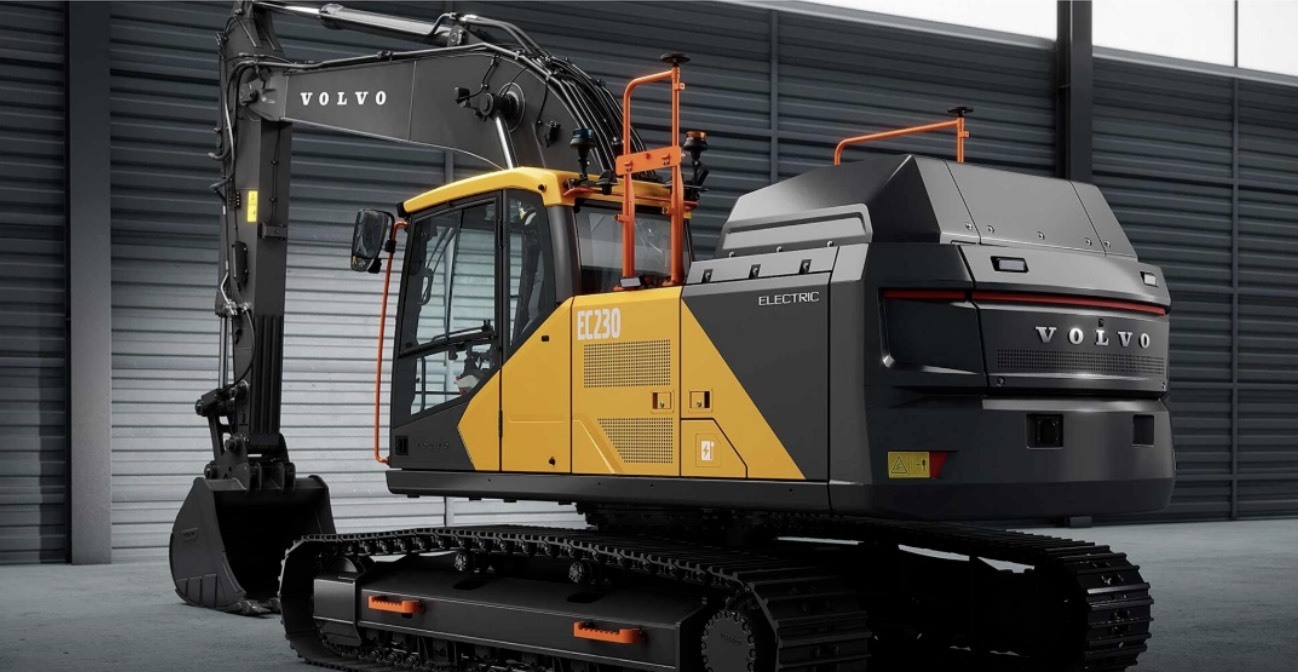
After selling its equity, VOLVO CE is adjusting its strategy in China, mainly including: focusing on providing Volvo-branded high-end products and services to specific customer groups in the Chinese market; building its China business system into a production center serving both domestic and export markets; and continuing to promote the integration of the Jinan Technology Center (JTC) into the global technology system, maximizing the use of Chinese resources to develop products for the global market.
Melker Jernberg, President of VOLVO CE, stated: "Since 2006, Shandong Lingong has created significant value for both parties. However, in the face of increasingly fierce market competition, the need for technological transformation, and the requirement to deepen customer cooperation, we need to refocus our strategy. China remains a key market for Volvo, and we will seize opportunities by deepening sustainable solutions in segmented fields while fully leveraging China's well-developed industrial system."
After the news was announced, Volvo Group's stock price rose 2.3% in early trading, indicating that the market holds a positive attitude toward its adjustment to focus on core businesses.
03 The Changing Situation of Chinese and Foreign Brands: The End of the "Market for Technology" Era
In the early days, foreign brands monopolized the high-end market with their technological and brand advantages, while Chinese manufacturing faced a "technology thirst" in many fields. Therefore, China promulgated and implemented the "Automobile Industry Policy" in 1994, first proposing "trading market for technology," which was later extended to the construction machinery field.
Facts have proven that in the early years, China's construction machinery industry introduced technology through "trading market for technology," but did not obtain core technologies, and even handed over some domestic brands and market share. For example, the former Hefei Mining Machinery Factory formed a joint venture with Japan's Hitachi Construction Machinery, with the Chinese side valuing its brand and channels at 23 million yuan for a 25% stake, yet transferring product development rights and procurement rights entirely. In just six years, this former excavator leader was wholly acquired by Hitachi, and the national brand completely disappeared.
The transfer of controlling rights of Shandong Lingong also profoundly reflects the compromise of Chinese enterprises at the time regarding the autonomy of core technologies.
During the technical cooperation between Shandong Lingong and Volvo, Lingong never mastered core technologies such as hydraulic systems, and high-end products still required the purchase of Volvo components. After 2015, Shandong Lingong increased investment in independent R&D, gradually replacing hydraulic systems with domestic ones (Hengli Hydraulic). Meanwhile, Lingong Heavy Machinery (LGMG) independently developed aerial work platforms, thereby avoiding Volvo's technological restrictions. This once again proves that core technologies cannot be bought; they can only be developed independently.
Currently, China's construction machinery industry has entered the "technology export" stage, with leading companies such as Zoomlion, Sany, and XCMG building factories in Europe and the United States, all confirming the necessity of independent development. After this transaction, the independent development process of Chinese brands will accelerate, and the pressure of "squeezing competition" from foreign brands in China will continue to escalate.
In the international market, foreign brands have long relied on global channels and brand heritage to maintain their advantages, but Chinese enterprises, through the "going global" wave and technological iteration, are gradually making breakthroughs in emerging markets such as those along the "Belt and Road." Cases such as Shandong Lingong prove that Chinese brands are shifting from "followers" to "competitors," and are expected in the future to reshape the global construction machinery competitive landscape through independent layout and ecosystem building.
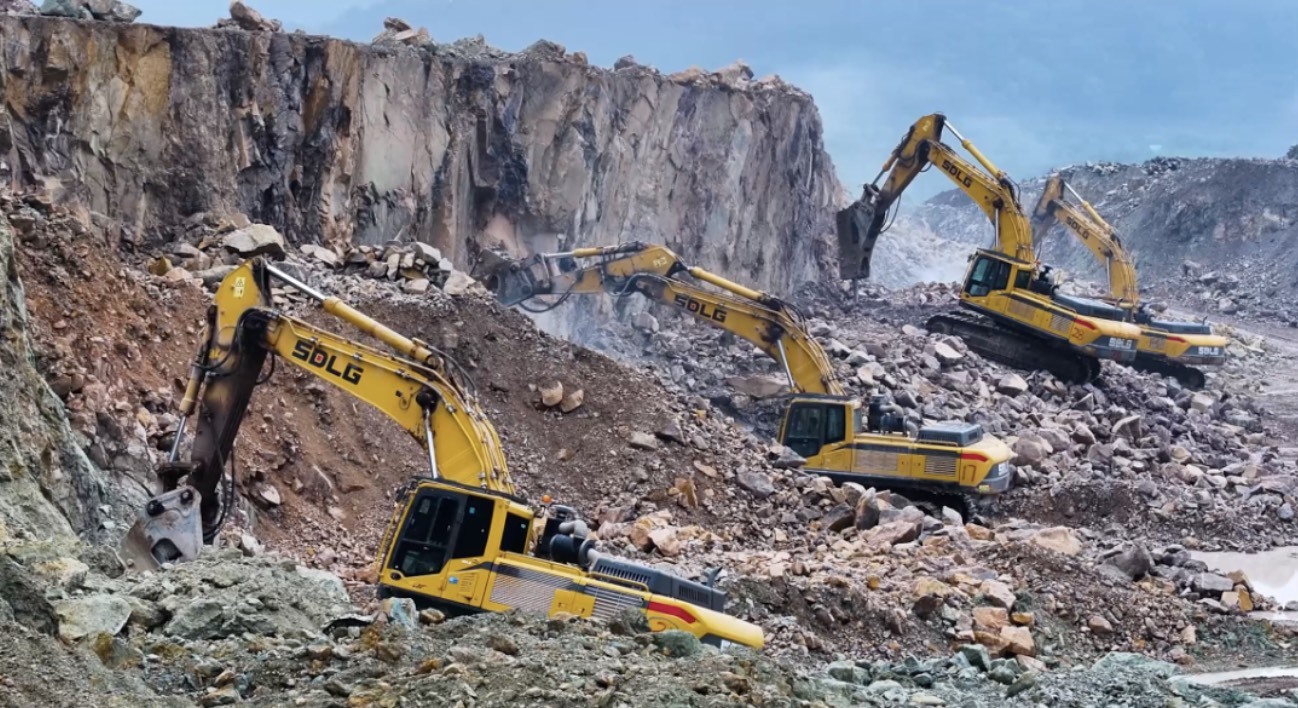
The "breakup" between Shandong Lingong and Volvo is not the end of cooperation, but a reshaping of the competition-cooperation model. Chinese brands will strengthen their global voice through independent development, while foreign brands will adjust their layout by focusing on core advantages. In the future, the two sides may find a new balance in technology sharing and market complementarity, driving the industry from "single competition" toward "symbiotic innovation" and accelerating the iteration of the global construction machinery industry landscape.
Australia's Tallest! Zoomlion ZT72J Straight-Boom Aerial Work Platform Delivered Overseas Again
下一篇SCMC Successfully Issues 2025 First Tranche of Sci-Tech Innovation Bonds

2026-09-28 1137 0
2026-09-24 10491 0

2026-09-23 10629 0
2026-09-22 10708 0

Lize City Air Terminal Underground Main Structure Nearing Completion: Maximum Transfer Walk Under 4 Minutes After Operation

Anti-seepage Curtain for Main Lock Pit of CSCEC Port Shenqiu Double-Line Lock Project Completed on Schedule

All Pile Foundations Completed on Quanzhou Baiqi Channel

Hainan Upgrades Housing and Municipal Infrastructure
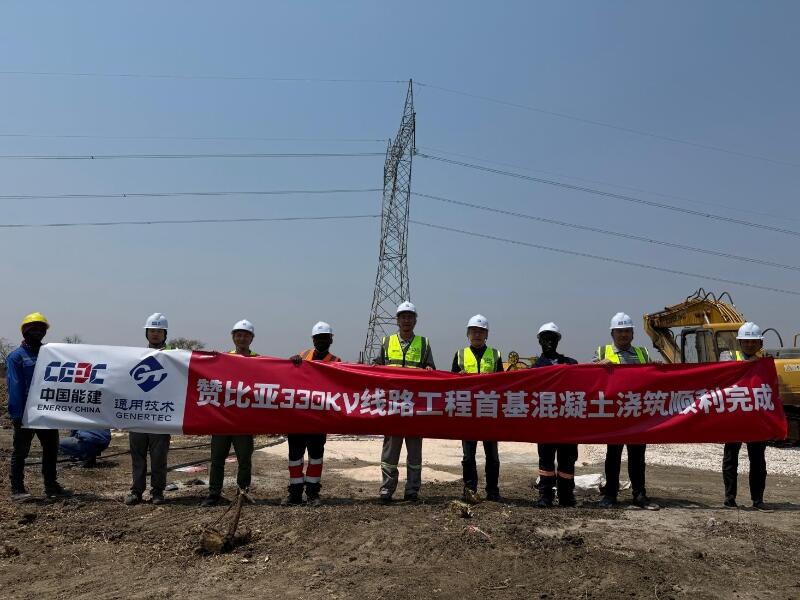
First Foundation Concrete Pour Successfully Completed for Zambia Kafue West–Muzuma 330kV Transmission Line EPC Project
Hot News

评论 (0)