The intermittency and volatility of renewable energy pose significant challenges to grid reliability after large-scale integration, and developing efficient, economical, and reliable energy storage technologies has become the key to overcoming the bottleneck of large-scale renewable energy application. Underground flow battery refers to a new type of energy storage technology that uses undergroundsalt cavernsor artificial caverns as large-scale storage spaces for the positive and negative electrolytes of ground flow batteries, and realizes energy storage and release through stacks. When salt caverns are used as electrolyte storage sites, it is necessary to consider that the basic occurrence characteristics of salt rock in China are many salt rock layers, thin single-layer thickness, and many insoluble or poorly soluble interlayers, belonging to a typical thin interbedded salt rock structure. Therefore, the construction of salt cavern flow batteries in China will inevitably encounter the influence of multiple interlayers and sediments on the electrochemical performance of flow batteries, as well as the influence of long-term electrolyte erosion on the mechanical and pore-permeability characteristics of surrounding rock, that is, the interaction mechanism between salt cavern occurrence characteristics and flow battery electrolytes. However, there is currently no research targetingthis mechanismTherefore, there is an urgent need to conduct in-depth research on this mechanism, seize the scientific and technological high ground, and provide theoretical basis and technical support for the innovation and development of salt cavern flow battery energy storage technology in China.
The relevant research led by the Oil and Gas Underground Storage and Development Research Center of the Institute of Rock and Soil Mechanics, Chinese Academy of Sciences, selected a positive electrolyte (MV) and a negative electrolyte (TMA-TEMPO) suitable for storage in salt caverns. Relying on a typical salt mine in China as the engineering basis, experiments were conducted on the influence of single ions in brine on the electrochemical performance of the positive and negative electrolytes, as well as full-cell performance tests using in-situ saturated brine as the supporting electrolyte, revealing the mechanism by which salt cavern occurrence characteristics affect the electrochemical performance of flow batteries. At the same time, tests were conducted on the pore-permeability characteristics of salt cavern surrounding rock under long-term electrolyte erosion at high temperature and high pressure, and low-frequency cyclic loading creep tests, revealing the mechanism by which long-term electrolyte erosion affects the pore-permeability characteristics of surrounding rock and the creep behavior of salt rock.
Furthermore, to solve the technical problem of uneven concentration distribution of active substances in salt caverns in current salt cavern flow batteries, the team proposed a positive-negative high-low four-cavity linked salt cavern flow battery system. This system deploys two salt caverns at the positive and negative ends respectively to store electrolytes before and after redox, effectively isolating electrolytes of different valence states, solving the technical problem of uneven concentration distribution of active substances in salt caverns, and ensuring the energy efficiency of salt cavern flow batteries during charge and discharge. This system not only retains the advantages of flexible power and capacity configuration, high efficiency, long life, and high safety of flow batteries, but also solves the problems of large floor area, high temperature control cost, and high environmental pressure of ground flow battery energy storage systems, achieving the collaborative system construction of low-cost, large-scale, and long-duration energy storage. At present, this system has applied for patents in China and the United States.
The research results were published in the top-tier journal in Category 1, Energy. The research work was supported by projects such as the National Key R&D Program, the Excellent Member of the Youth Innovation Promotion Association of the Chinese Academy of Sciences, and the Excellent Young Scientists Fund of the National Natural Science Foundation of China.
Paper link:
https://www.sciencedirect.com/science/article/pii/S0360544225024533

Figure 1 Four-cavity linked salt cavern flow battery system

Figure 2 Cathode electrolyte TMA-TEMPO erosion treatment: (a) relationship between porosity and permeability of interlayer samples and erosion duration; (b) relationship between porosity and permeability of salt rock samples and erosion duration
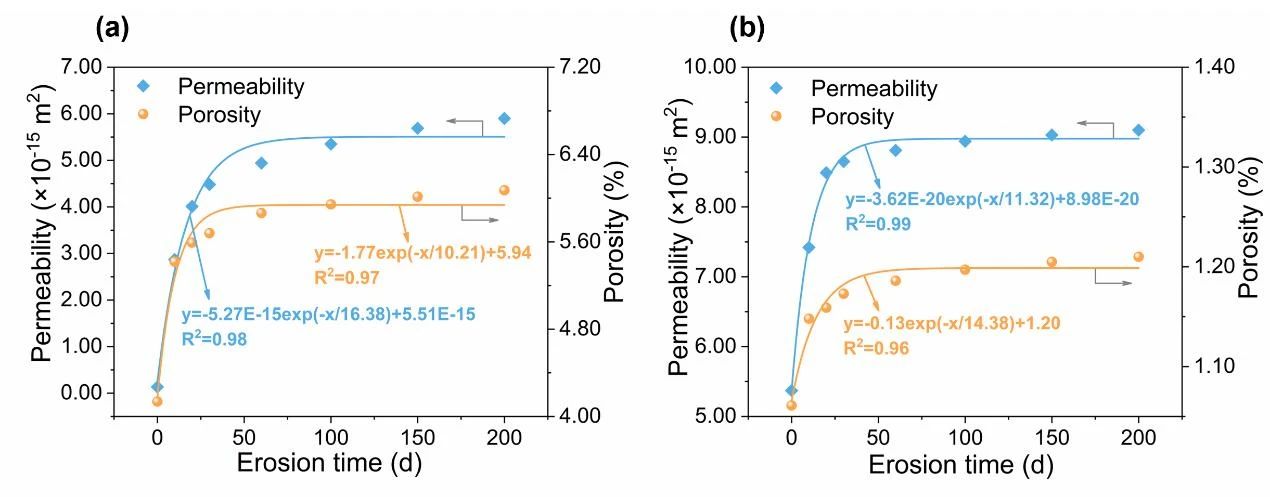
Figure 3 Anode electrolyte MV erosion treatment: (a) relationship between porosity and permeability of interlayer samples and erosion duration; (b) relationship between porosity and permeability of salt rock samples and erosion duration

Figure 4 Rate performance and stability of TMA-TEMPO/MV using in-situ saturated brine from a salt mine as the supporting electrolyte: (a) discharge capacity at different current densities; (b) Coulombic efficiency and energy efficiency at different current densities; (c) discharge capacity after 200 cycles at electrolyte concentrations of 0.05, 0.25, and 1.5 M at 40 mA·cm-2; (d) charge-discharge curves corresponding to the 1st, 50th, 100th, 150th, and 200th cycles
Frontier Technology | Study on the Bearing Performance of a Novel Caisson-Slab Gravity Anchor for Offshore Wind Power
下一篇Company News | Jiancheng Pile Company Successfully Passes Re-evaluation as a Tianjin "Specialized, Refined, Distinctive and Innovative" SME

2026-09-28 1157 0

2026-09-24 10586 0

2026-09-23 10714 0

2026-09-22 10808 0

Lize City Air Terminal Underground Main Structure Nearing Completion: Maximum Transfer Walk Under 4 Minutes After Operation

Anti-seepage Curtain for Main Lock Pit of CSCEC Port Shenqiu Double-Line Lock Project Completed on Schedule

All Pile Foundations Completed on Quanzhou Baiqi Channel

Hainan Upgrades Housing and Municipal Infrastructure

First Foundation Concrete Pour Successfully Completed for Zambia Kafue West–Muzuma 330kV Transmission Line EPC Project
Hot News

评论 (0)