On April 20, 2025, the reconstructed section of Beijing's East Sixth Ring Road (Jingha Expressway–Luyuan North Street), which took five years to build, officially opened for trial operation. The East Sixth Ring Road reconstruction project is approximately 16.3 km long and is divided into a ground widening section and an underground reconstruction section, of which the roadbed widening section is about 7.1 km long and the tunnel section is about 9.2 km long. Within the tunnel section, the shield-driven portion is about 7.37 km long, making it the longest shield-driven expressway tunnel in China at present.
East Sixth Ring Road Tunnel In this reconstruction project, two key technologies developed by Professor Cheng Xiaohui's team at the Institute of Underground Engineering, Department of Civil Engineering, Tsinghua University—"energy tunnel" and "distributed optical fiber monitoring"—played an important role, injecting green innovation momentum into the project.
Energy Tunnel: Geothermal Utilization Supports the "Dual Carbon" Goals The tunnel section of the East Sixth Ring Road is located in Tongzhou District, Beijing, with an average overburden depth of about 20 m. The geological conditions consist of water-rich sand layers, offering a natural advantage for developing shallow geothermal energy. Through theoretical analysis, numerical simulation, and field tests, the Tsinghua research team carried out key technology research on energy tunnels based on the tunnel section of the East Sixth Ring Road reconstruction project, solving the problems of traditional ground-source heat pump technology such as high investment, large occupation of underground space, and low heat exchange efficiency. Energy Tunnel Test Section By installing heat exchange pipes in the invert area of the shield tunnel in the East Sixth Ring Road reconstruction project, the research team transformed a conventional shield tunnel into an energy tunnel, enabling the tunnel both to bear the load of the surrounding rock and to extract geothermal energy, providing clean energy for building heating and cooling as well as road snow melting and de-icing.
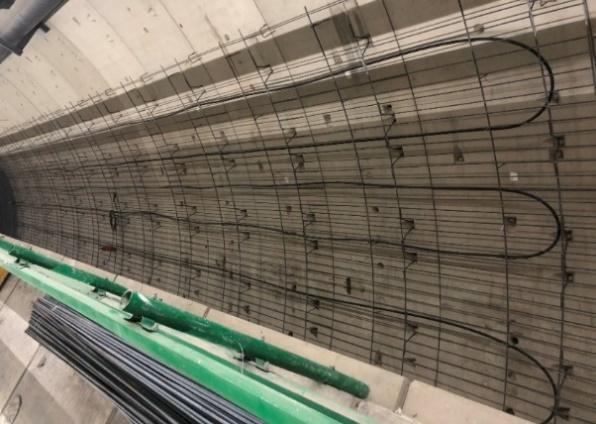
Energy Shield Tunnel Construction Site Geothermal Energy Extraction by the Energy Tunnel The East Sixth Ring Road reconstruction project has built about 800 m of energy tunnel, meeting the heating and cooling load demand of the 1,226.3 m² building in the East Sixth Ring Road South Management Area, and is also used for winter snow melting and de-icing on about 40 m of road on the F6 ramp of the East Sixth Ring Road. Compared with conventional ground-source heat pump systems, this technology saves about 49% of initial investment costs, achieving significant economic and environmental benefits. Schematic of Geothermal Energy Extracted by the Energy Tunnel for Building Supply Energy Tunnel Plant Room Construction Site of the Energy Tunnel Snow Melting and De-icing Section


Distributed Optical Fiber Monitoring: Intelligent Technology Safeguards Structural Safety Based on the principle that the Brillouin scattering frequency shift in optical fiber has a linear relationship with the strain and ambient temperature change of the fiber, optical fiber is used to perform distributed measurement of structural strain, offering the advantages of continuous and dense monitoring points and low cost.

Principle of Distributed Optical Fiber Monitoring Using distributed optical fiber technology, the research team investigated the mechanical response of the energy shield tunnel structure and the mechanism of interaction with the surrounding rock under the combined action of surrounding rock load and temperature load, developed an energy tunnel monitoring method integrating optical fiber sensors, and verified the monitoring results.

Layout of Distributed Optical Fiber and Verification Sensors Using distributed optical fiber monitoring technology, the research team successfully monitored the structural response of the main line tunnel's shield segments and temporary steel supports during the freezing method construction of the East Sixth Ring Road cross passage, providing reliable assurance for construction safety.

Construction Site of the Cross Passage Using the Freezing Method Distributed Optical Fiber Monitoring Site Green Innovation Leads the Future The East Sixth Ring Road reconstruction project is a key transportation project in Beijing and a model of green technology application. The two key technologies from Professor Cheng Xiaohui's team not only enhanced the project's scientific and technological content, but also provided an important reference for China to achieve its "dual carbon" goals and promote smart transportation development. In the future, these technologies are expected to be promoted nationwide, helping more infrastructure projects achieve the dual goals of energy conservation and environmental protection and efficient operation. With the opening of the reconstructed East Sixth Ring Road section, the transportation network of Beijing's sub-center has been further improved, while also demonstrating the strong potential of scientific and technological innovation in major projects. Tsinghua University's "energy tunnel" and "distributed optical fiber monitoring" technologies are becoming new engines driving sustainable urban development.
Project News | World's Largest-Span Double-Deck Steel Truss Cable-Stayed-Suspension Hybrid Road-Rail Bridge: North Anchorage Caisson of Libu Yangtze River Road-Rail Bridge Sinks Accurately into Place
下一篇Figure Column | Liu Hanlong: Writing a "Chinese Solution" in the Field of Geotechnical Engineering

2026-09-28 1157 0

2026-09-24 10586 0

2026-09-23 10714 0

2026-09-22 10808 0

Lize City Air Terminal Underground Main Structure Nearing Completion: Maximum Transfer Walk Under 4 Minutes After Operation

Anti-seepage Curtain for Main Lock Pit of CSCEC Port Shenqiu Double-Line Lock Project Completed on Schedule

All Pile Foundations Completed on Quanzhou Baiqi Channel

Hainan Upgrades Housing and Municipal Infrastructure

First Foundation Concrete Pour Successfully Completed for Zambia Kafue West–Muzuma 330kV Transmission Line EPC Project
Hot News

评论 (0)