Expanding the "five new businesses"—technological innovation is a key driving force. As a new market and new field, the caisson-type vertical shaft project requires the slurry circulation slag-discharge system of the boring machine to break conventional design ideas and methods, from the slag-discharge direction to the selection of pumps, valves, and pipes.
In this issue of "Strivers Around Us," we visit the fluid technology research team for shaft boring machines at the Hydraulic Research and Design Institute, to talk about their innovation stories and explore how technological innovation is used to capture new markets and new fields and achieve "inverted slag discharge" for shaft boring machines.
Spring rain drizzles, nourishing the earth. At the CRCHI Changsha Second Industrial Park, where a light rain is falling, workers in the workshop are busy with assembly, and technicians in the R&D building are busy drawing designs.
With diligent people, spring is even more vibrant, and orders keep coming in.
At the Hydraulic Research and Design Institute, technician Lin Jin is calculating parameters for a new product at hand. He is designing a slurry circulation slag-discharge system for a shaft boring machine, with a maximum excavation diameter of 23 meters, a maximum excavation depth of 60 meters, and a slag-discharge efficiency of 40 cubic meters per hour. According to the actual engineering requirements and application scenarios, Lin Jin skillfully uses a set of complex formulas, continuously substituting data such as the formation moisture content, maximum water and soil pressure, and maximum tunneling speed to calculate the performance matching parameters of the equipment's slurry circulation slag-discharge system.
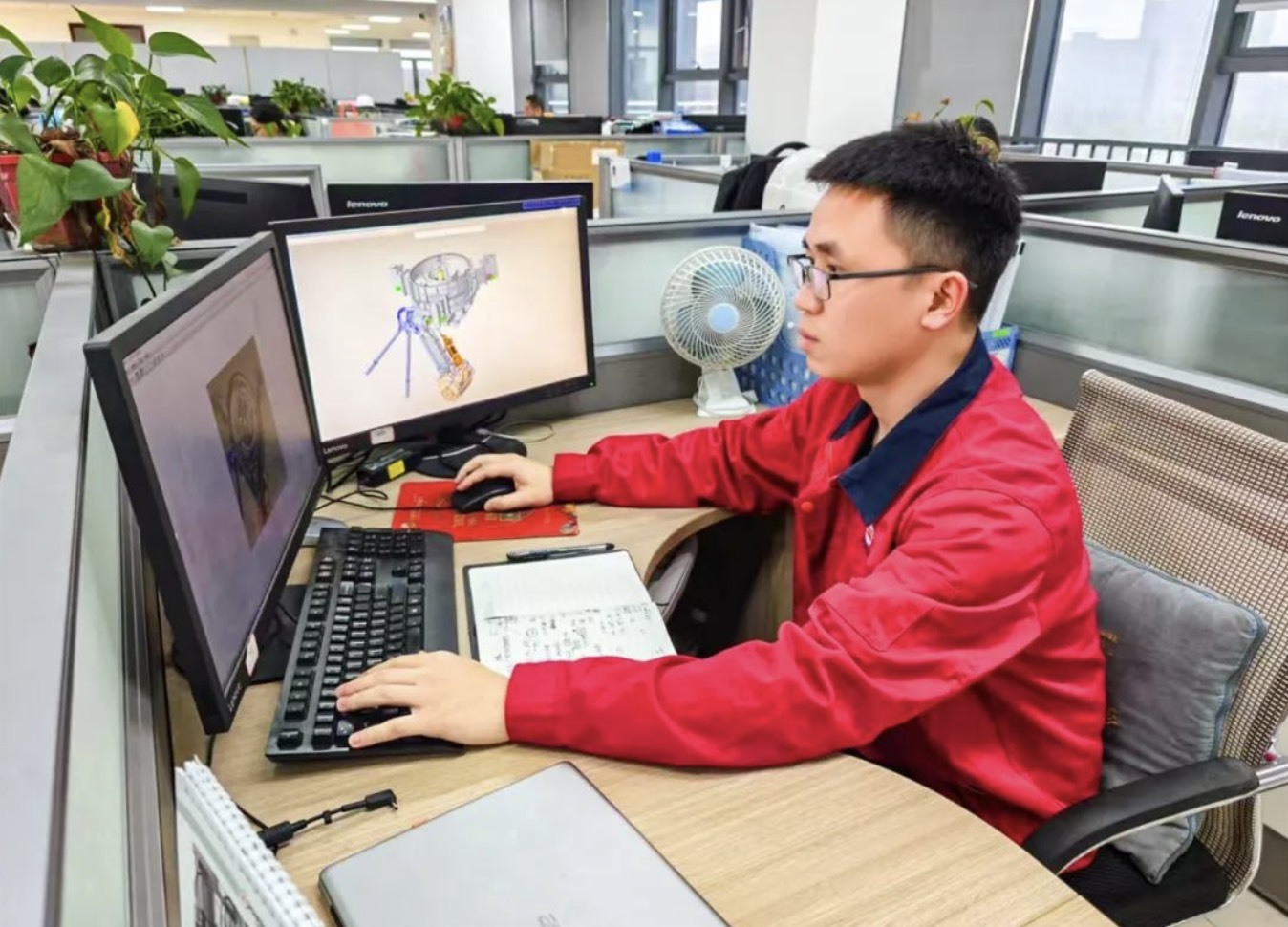
Technician designing the circulation system
Design flow rate 600 cubic meters per hour, in-pipe flow velocity 4 meters per second. After a while, Lin Jin successively calculated the required parameters of the slurry circulation slag-discharge system. Next comes the selection of key components such as pumps and pipe diameters.
"Doing design now is very handy." Although young, Lin Jin has already participated in the design of five caisson-type shaft boring machines, which have been successfully applied in multiple shaft projects. Such application performance has already enabled CRCHI to far surpass peer enterprises and stand at the industry-leading level.
However, from being proficient in slurry balance shield machines to becoming an expert in shaft boring machines, the technical breakthrough of the slurry circulation slag-discharge system involved many twists and turns.
"The first is the change in the slag-discharge direction. The circulation system goes from horizontal to vertical, and the pump submerges 30 to 60 meters downward." "The second is that the pumps and valves are all submerged in slurry and also need to agitate it, which places extremely high requirements on motor waterproofing, mechanical seals, follow-up compensation, shock resistance, wear and erosion resistance, and muck passability," said Dr. Liu Le, head of the shaft boring machine fluid technology research team and deputy director of the Basic Technology Research Institute, with full clarity about the technical bottlenecks.
In order to quickly seize new markets and new fields, the Hydraulic Research and Design Institute established the shaft boring machine fluid technology research team, selecting elite personnel from the Boring Machine Fluid Research Institute and the Basic Technology Research Institute to focus on this technical challenge.
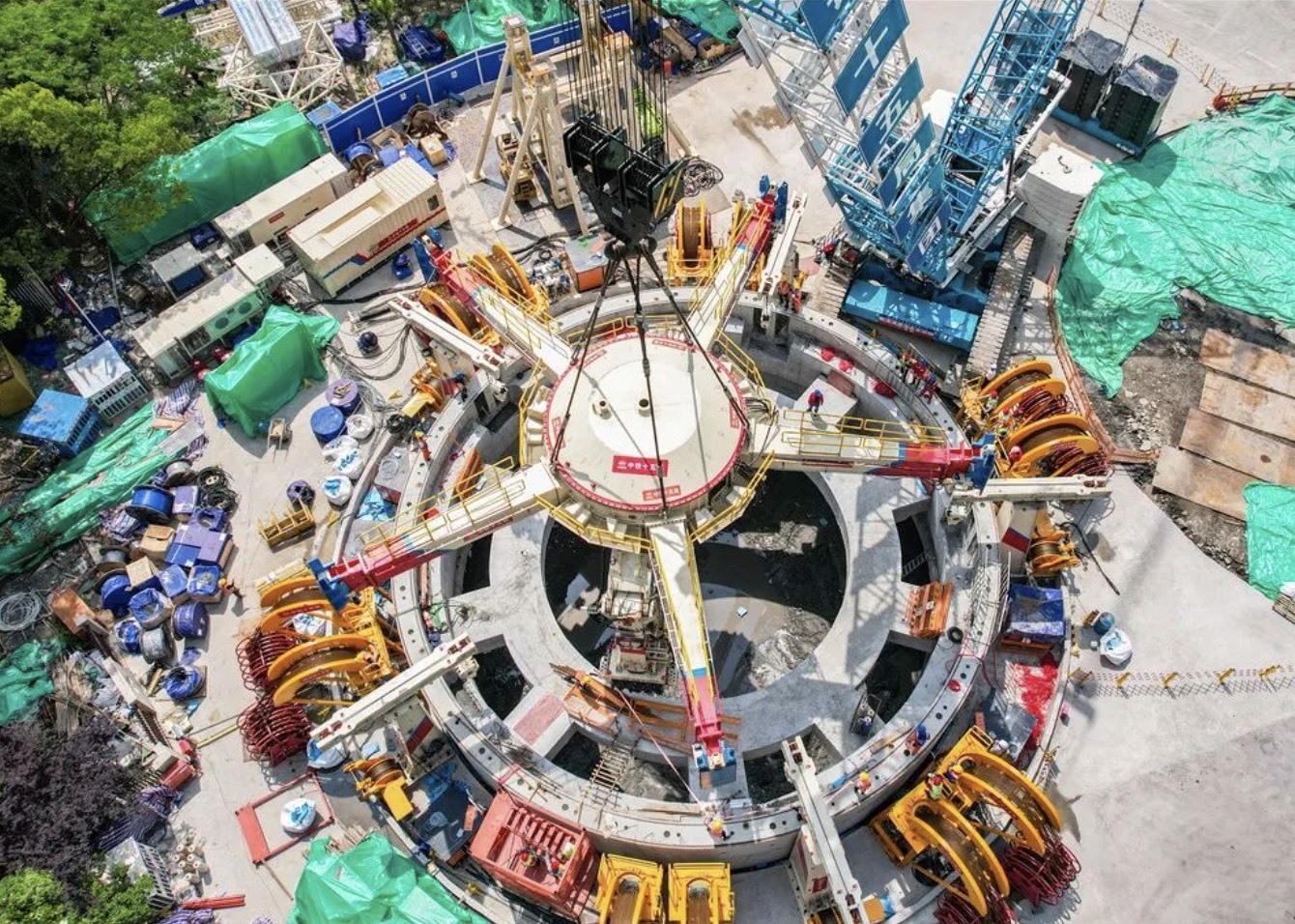
The world's largest-diameter shaft boring machine "Dream" being lowered into the shaft
From horizontal slag discharge in horizontal tunnel equipment to achieving "inverted slag discharge" in caisson equipment, the previous design ideas and methods have been changed. Because the slurry pump remains submerged in slurry for long periods in harsh operating conditions, the research team carried out technical breakthroughs item by item targeting the slurry pump's mechanical seals, internal and external pressure differences, and other issues.
At the beginning of the project, the research team found through market research that some domestic supporting manufacturers had production experience with submersible slurry pumps for deep-sea mining. However, seawater is relatively clear and far from being able to adapt to the high-concentration, large-particle slurry environment faced by caisson projects.
Therefore, the research team contacted foreign supporting manufacturers. "Out of technical considerations, the foreign side also took a stance of not wanting to sell, and the delivery period was as long as one year, with a high price." Liu Le believed that this was not a long-term solution and that domestic supporting manufacturers must be enlisted to overcome this difficulty.
Limited by the existing assembly methods of domestic supporting manufacturers, the submersible slurry pump initially adopted a single mechanical seal. When the research team took it to the factory for testing, problems such as slurry leakage and motor short circuits immediately emerged.
Based on comparative analysis with foreign products, the research team proposed adopting a dual mechanical seal solution. "The dual mechanical seal can form a sealed chamber to isolate sand and mud, and then compensation oil is injected into the chamber to provide a certain balancing pressure and compensate in real time for the pressure difference inside and outside the sealed chamber," Liu Le said.
The idea was good, but implementation was not easy. Domestic supporting manufacturers had never made similar products, so the research team patiently carried out technical liaison. For the supervision and on-site monitoring of just the dual mechanical seal process alone, team members made seven or eight trips one after another. Perseverance pays off. Through the unremitting efforts of the research team, a domestic submersible slurry pump using a dual mechanical seal was successfully trial-produced.

Submersible slurry pump test bench
"The successful development of the domestic pump not only helped supporting manufacturers accumulate design experience and upgrade manufacturing processes, but its price is also less than one-third that of similar foreign products," Liu Le said with gratification.
Once the mechanical seal technology was solved, the issue of follow-up compensation followed.
"As the caisson depth continuously changes, the external pressure on the slurry pump increases accordingly, reaching up to 6 bar at the deepest point." Liu Le analyzed that if the internal and external pressure difference becomes unbalanced, slurry leakage will occur.
To this end, the research team first considered a hydraulic oil circulation compensation device. "The circulation of compensation oil can carry away heat from the sealed chamber, but because the sealed chamber and pipelines have small capacity, the hydraulic solution needs to be connected to a ground pump station. The long distance between regulating valves and pressure regulation points causes pressure fluctuations in the sealed chamber, making precise adjustment difficult." Fang Xiaolong, director of the Boring Machine Fluid Research Institute, analyzed that this method has both advantages and disadvantages and is not suitable for engineering applications.
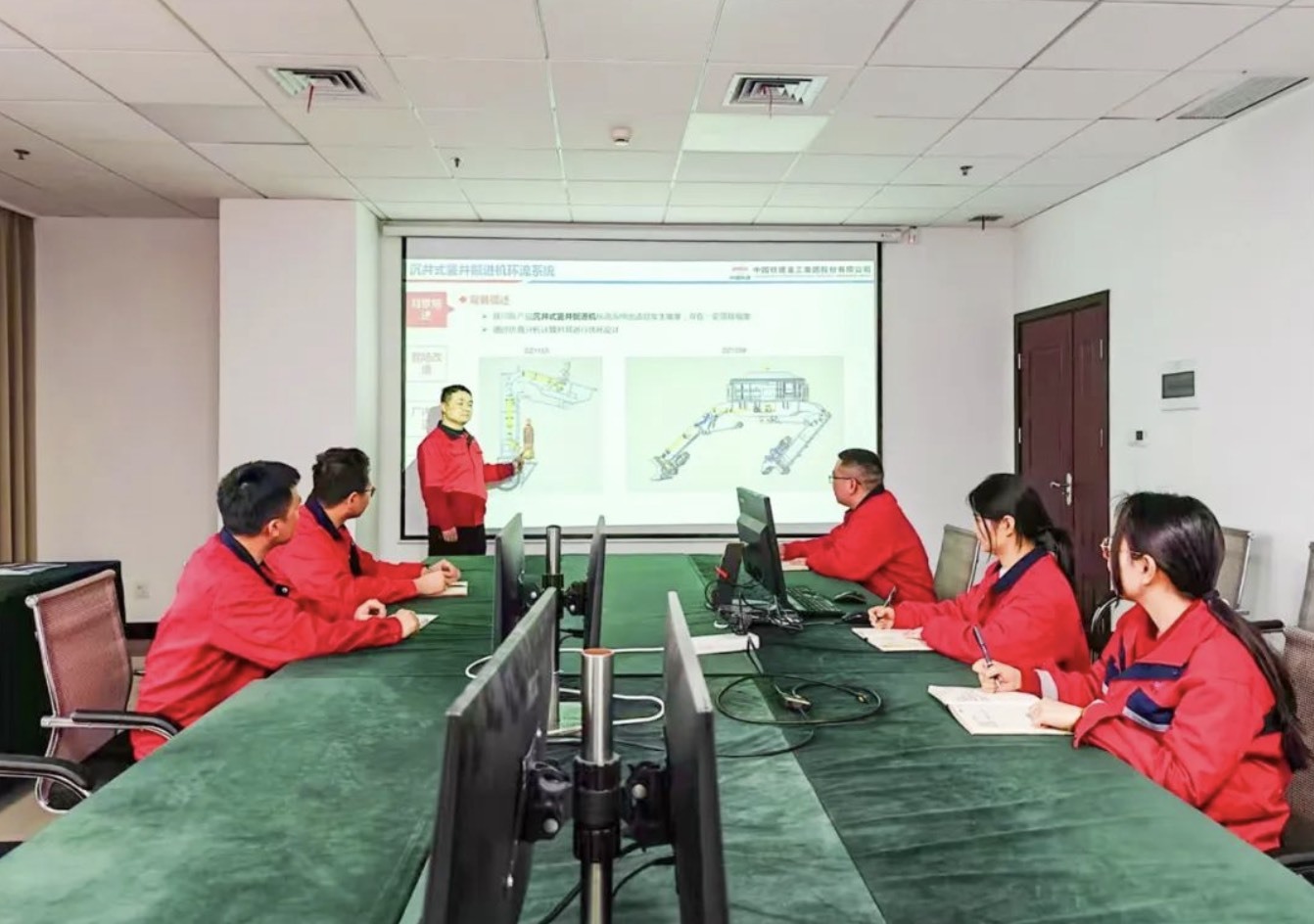
The research team discussing the technical solution
For this reason, Liu Le and Fang Xiaolong organized the research team for concentrated discussion, allowing everyone to express their views and pooling "golden ideas." They decided to try a gas pressure compensation method. "Gas is like a spring and can buffer various impacts and disturbances. By indirectly regulating the oil pressure through gas pressure, control is stable and pressure fluctuations are small." Liu Le thought this method was feasible and put it into testing.
The difficulty of the gas pressure compensation method lies in determining how much gas pressure compensation is needed as the excavation depth changes. On the one hand, the gas pressure cannot be too low, or it will not provide compensation. On the other hand, the gas pressure cannot be too high, or oil consumption will be large.
In order to find this optimal value, the research team stayed at the caisson slurry circulation test bench, setting different balancing pressure differences and observing and recording in real time the oil level scale and pressure conditions of the compensation tank. Their efforts paid off: the team successfully determined a suitable balancing pressure difference and controlled fluctuations in the sealed chamber's balancing pressure to within 0.1 bar.
With technological breakthroughs and new products, the research team successfully developed the caisson slurry circulation slag-discharge system and applied it to domestic first-of-their-kind caisson boring machine projects such as "Future" and "Dream."
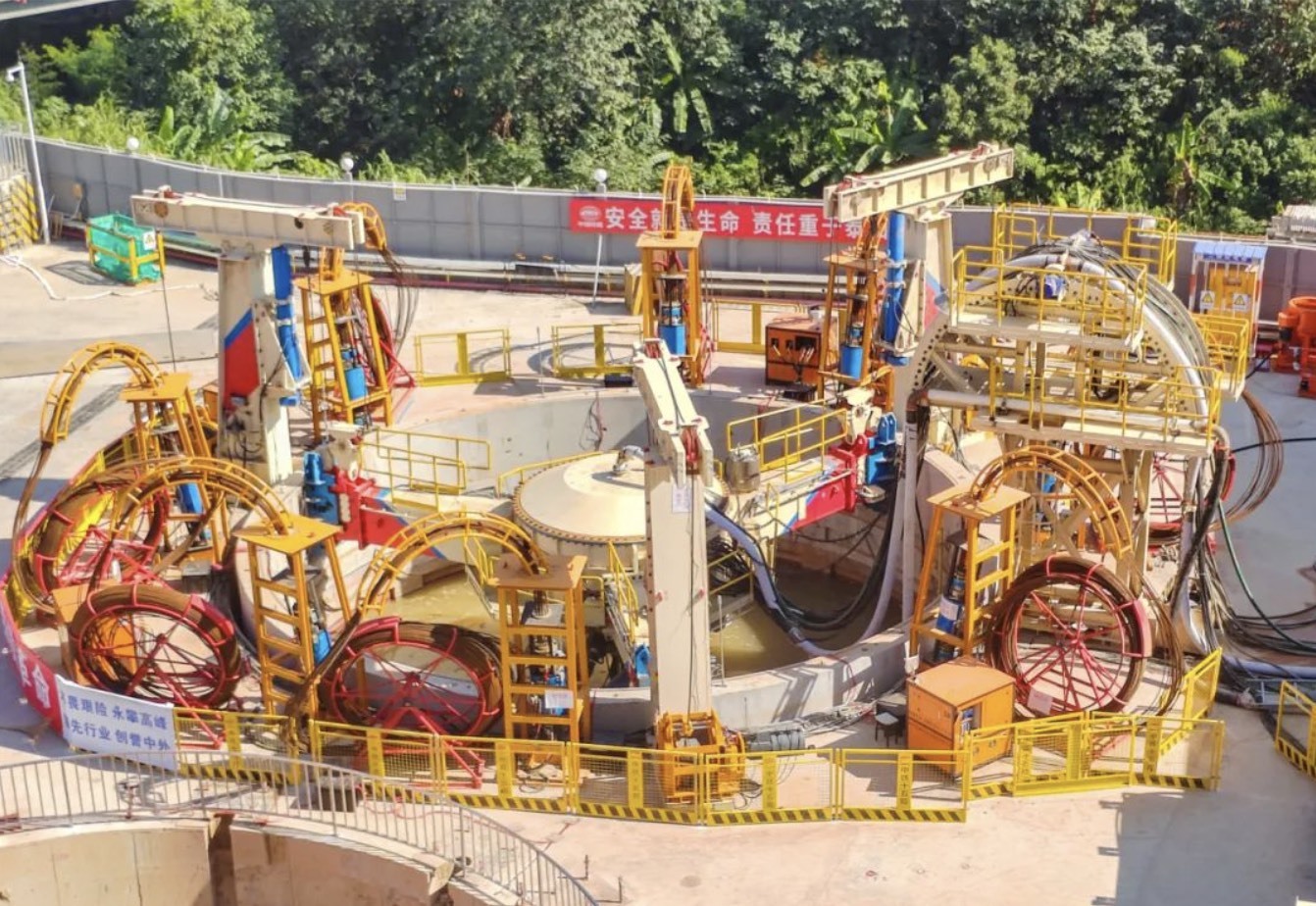
Excavation operation of "Dream"
Just when the research team thought they could relax, news came from the construction site that in early applications the equipment had experienced blockage in the muck chamber.
The muck chamber is the starting point of the slurry circulation slag-discharge system. Muck and water mix into slurry inside the chamber and are then discharged through pipes by pumps. The muck chamber of the shaft boring machine is shaped like an inverted triangle, with the slurry outlet at the top. The muck at the bottom needs to be lifted and delivered to the pump suction inlet for smooth discharge.
Through on-site chamber inspection, it was found that muck had deposited at the bottom. "It was judged that there were problems with the scouring angle, number of scouring ports, and scouring positions, causing the muck in the chamber to fail to flow effectively and creating circulation dead zones, seriously reducing the slurry's muck-carrying efficiency." Liu Le frowned and resolved to improve the scouring device.
In the existing design, there was only one scouring pipeline, located at the top of the muck chamber and far from the suction inlet. The research team first carried out simulation design, attempting to optimize the scouring angle and position and adjust the scouring flow rate to improve the flow conditions inside the chamber.
Technician Ning Jian, who was responsible for the simulation design, established a two-phase coupled flow model in simulation software. Through model establishment, he identified defects in the existing design and continuously sought the optimal solution.
"We tried more than 20 scouring schemes, conducting comparative analysis and iterative improvement again and again, determined to find the optimal scouring angle, position, and flow distribution." Ning Jian spent one month completing the simulation design.
Having taken the first step, confidence also grew. According to the simulation test scheme, the research team carried out test verification at the factory. Liu Le and Lin Jin, Fang Xiaolong and Zhu Wenchu, worked in pairs and took turns on duty.
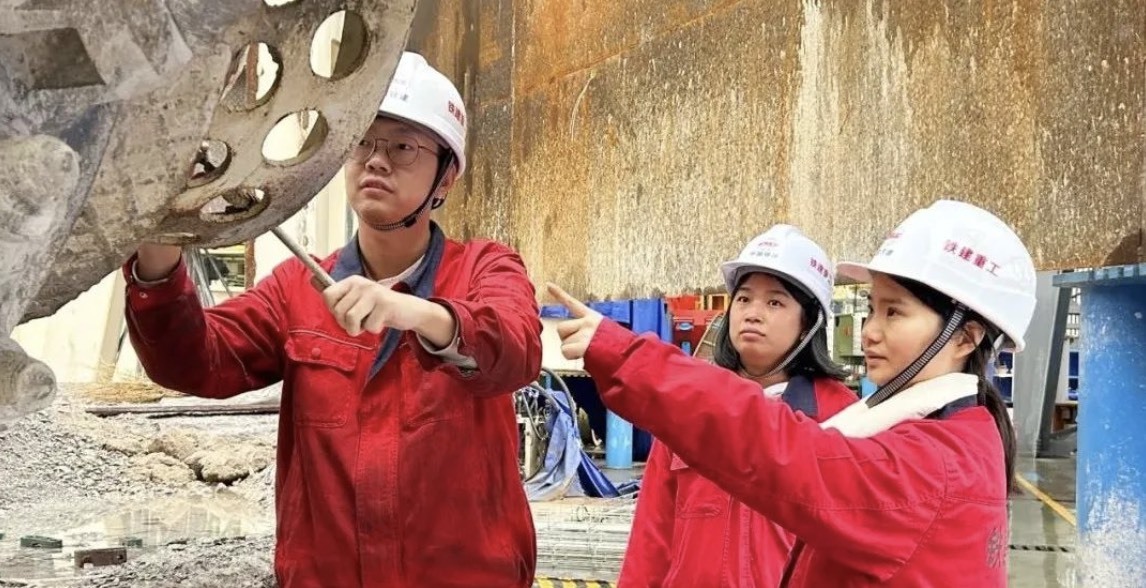
Research team members inspecting equipment
The tests were conducted in winter, and the caisson slurry circulation test bench was an outdoor installation. "The north wind blew whistling against our faces, especially cold." Technician Zhu Wenchu remembered it vividly. During testing, they could not stay entirely in the main control room and had to conduct regular equipment inspections, climbing up to the installation to check the operation of the slurry circulation system.
The research team spent two weeks first verifying the parameters of the test data against the simulation data to verify the accuracy of the simulation data; then, according to the simulation scheme, they carried out engineering experiments to demonstrate the effectiveness of the scheme.
During the tests, it was common for shoes to be covered in mud and clothes to be soaked with water. But Zhu Wenchu felt that all the effort was worth it. After the new scouring scheme was applied in engineering, not only was there no more chamber blockage, but the equipment's overall tunneling efficiency increased by 60%. For this technological innovation, the research team laid out more than 10 patents.
Advancing continuously through innovation, the research team is now focusing on high-pressure, large-depth composite formation shaft projects with burial depth of more than 100 meters, carrying out technical breakthroughs in high-pressure slurry circulation slag-discharge systems to support the high-quality development of CRCHI's strategic emerging industries. "We are also making technical reserves for slag-discharge technology for kilometer-level vertical shafts," Liu Le said. The team is becoming ever more courageous in innovation and full of confidence.
Sunward's High-End Engineering Equipment Smart Factory Project Wins "2024 China Intelligent Manufacturing Best Application Practice Case"
下一篇SANY Heavy Machinery 2025 Quality Pledge Conference Concludes Successfully!

2026-09-28 1157 0
2026-09-24 10586 0
2026-09-23 10714 0
2026-09-22 10808 0

Lize City Air Terminal Underground Main Structure Nearing Completion: Maximum Transfer Walk Under 4 Minutes After Operation

Anti-seepage Curtain for Main Lock Pit of CSCEC Port Shenqiu Double-Line Lock Project Completed on Schedule

All Pile Foundations Completed on Quanzhou Baiqi Channel

Hainan Upgrades Housing and Municipal Infrastructure
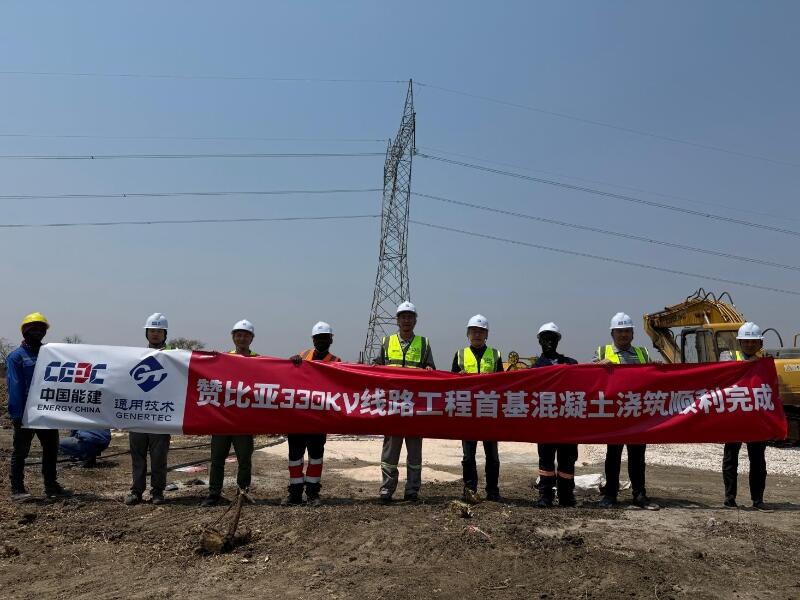
First Foundation Concrete Pour Successfully Completed for Zambia Kafue West–Muzuma 330kV Transmission Line EPC Project
Hot News

评论 (0)