
2025 is a pivotal year for China's economic structural transformation and high-quality development. The Government Work Report of the State Council explicitly sets forth goals such as "promoting the integration of technological innovation and industrial innovation" and "accelerating the digital transformation of manufacturing," injecting new momentum into the construction machinery industry. Combining policy orientation with industry dynamics, this article analyzes which core signals the Government Work Report has released from the aspects of the macroeconomic environment, infrastructure construction, technological innovation, and international development.

Macroeconomic Environment: Dual Drivers of Policy Support and Demand Recovery
In 2025, the construction machinery industry, stimulated by both policy dividends and market demand, demonstrates strong recovery potential. The Government Work Report emphasizes "deepening the implementation of major technological transformation and upgrading of the manufacturing sector and large-scale equipment renewal projects," directly driving the release of renewal demand for existing equipment. It is predicted that in 2025 the construction machinery industry's revenue will reach 910 billion yuan, a year-on-year increase of approximately 3.8%.
In addition, green and low-carbon transformation has become a policy priority. The report calls for "accelerating the development of a green and low-carbon economy" and "actively and prudently advancing carbon peaking and carbon neutrality," prompting construction machinery enterprises to accelerate their layout toward electrification and intelligentization. For example, the penetration rate of electricloadershad reached 10.4% in 2024. The 2025 government work tasks emphasize "accelerating the comprehensive green transformation of economic and social development," which will not only boost domestic demand but also promote industry structural optimization and facilitate the domestic substitution process.

Infrastructure Construction: Steady Growth and Emerging Fields Advancing Together
Infrastructure investment remains the core engine of construction machinery demand. In 2024, 3,113 kilometers of new high-speed rail were added, and railway construction continued to gain momentum; meanwhile, the strategy of "promoting new urbanization and coordinated regional development" proposed in the Government Work Report further expands the application scenarios of construction machinery. Through "deepening the implementation of the new urbanization strategic action" and "intensifying the implementation of regional strategies," it will drive demand growth for the full range of construction machinery equipment, releasing four core signals to the construction machinery industry:
1. Expansion of infrastructure demand: County-level efforts to shore up weak links, urban renewal, flood control and drainage, and underground utility tunnel construction directly drive demand for traditional construction machinery such as earthmoving machinery and concrete equipment.
2. Differentiated regional layout: Western development/Northeast revitalization focuses on traditional infrastructure, while smart city upgrading in the east gives rise to new scenarios for intelligent and unmanned construction machinery.
3. Green and intelligent transformation: Digital infrastructure and age-friendly renovation are forcing equipment to iterate toward electrification and intelligent perception (such as AI inspection robots). As real estate faces considerable adjustment pressure, the construction machinery industry should actively seek incremental growth in non-real-estate fields (such as new energy infrastructure and mining). For example, the mining machinery market, with the global open-pit mining equipment scale reaching US$24 billion, has become a new growth point.
4. Collaborative sinking of the industrial chain: The gradient transfer of industries in the central and western regions promotes the development of supporting service markets such as equipment leasing and second-hand equipment circulation.
The policies not only safeguard the existing market of traditional construction machinery (such as county-level infrastructure) but also open up high-end incremental space (such as smart construction in the east) through intelligentization and greening, collectively building a "traditional + emerging" dual growth curve for the industry.

Technological Innovation: Developing New Quality Productive Forces in Accordance with Local Conditions
Technological upgrading is the key for the construction machinery industry to break through cycles. The Government Work Report explicitly states "AI+", "expanding the large-scale application of 5G," and "accelerating the innovative development of the industrial internet," emphasizing "developing new quality productive forces in accordance with local conditions and accelerating the construction of amodernindustrial system," driving the construction machinery industry to accelerate toward digitalization and intelligentization and releasing four core signals to the industry:
1. Technology upgrading orientation: Accelerate independent research and development of high-end equipment, break through technical bottlenecks in key components, and promote the deep application of intelligent and digital technologies.
2. Equipment renewal dividends: The large-scale equipment renewal policy will directly stimulate incremental demand in the industry and create a market for replacing outdated equipment.
3. Accelerated digital transformation: The integrated application of industrial internet + 5G is forcing the industry to transform towardremoteoperation and maintenance and intelligent construction solutions, and opportunities for service provider ecosystem development are emerging.
4. Collaborative industrial innovation: The deep integration of AI large models with construction machinery scenarios is creating windows for new intelligent construction equipment and business model innovation.
International Development: Deepening the Belt and Road Initiative and Global Layout
Chinese construction machinery enterprises are accelerating globalization. The Government Work Report proposes "expanding high-level opening up, actively stabilizing foreign trade and foreign investment," "promoting high-quality Belt and Road cooperation to go deeper and become more substantive," "advancing major landmark projects and 'small and beautiful' people's livelihood projects in a coordinated manner," and "ensuring the stable and smooth operation of China-Europe freight trains and accelerating the construction of the New International Land-Sea Trade Corridor," helping export growth and releasing five core signals to the construction machinery industry:
1. Expanded overseas opportunities: Foreign trade stabilization policies + overseas infrastructure projects (Belt and Road, China-Europe freight trains) directly drive export demand for construction machinery, and intermediate goods trade expands space for component exports.
2. Cross-border ecosystem upgrading: Overseas warehouses/smart customs construction reduce logistics costs, and cross-border e-commerce policies help small and medium-sized construction machinery enterprises reach emerging markets.
3. Foreign investment technology feedback: Expanding foreign investment access in manufacturing may introduce high-end equipment manufacturing technology, forcing local enterprises to accelerate intelligent transformation.
4. Standard internationalization: Participation in negotiations on agreements such as CPTPP/DEPA promotes the alignment of Chinese construction machinery standards with international standards and breaks through overseas certification barriers.
5. Enhanced supply chain resilience: Free trade zone/comprehensive bonded zone policies optimize global supply chain layout and disperse geopolitical risks.
Through the dual drivers of "trade infrastructure + institutional opening up," the policies both open up incremental space in the infrastructure markets of developing countries (such as ASEAN and Africa) and leverage high-standard free trade agreements to break through access bottlenecks in high-end markets in Europe and the United States. The risk point lies in the need to guard against rising trade protectionism in some countries, but overall this injects strong momentum into the globalization 2.0 of construction machinery (from simply selling equipment to exporting a "product + standard + service" ecosystem).
The 2025 Government Work Report has anchored the transformation path of "technological breakthrough + scenario boundary-breaking" for the construction machinery industry. It both consolidates the basic foundation of traditional infrastructure demand with policy dividends and opens up new battlefields of intelligentization and globalization with new quality productive forces. Under the resonance of macroeconomic policy and market demand, the industry is moving from "scale expansion" toward "value leap"—reconstructing product competitiveness through greening and digitalization, breaking through globalization barriers via the Belt and Road Initiative and free trade agreements, and strengthening industrial chain resilience by relying on the specialized, refined, distinctive, and innovative ecosystem. Despite challenges such as high investment in technological iteration and increasingly complex international competition, the policy orientation clearly indicates that the construction machinery industry has reached a critical juncture in its leap from "Made in China" to "Intelligently Made in China." In the future, only by taking innovation as the spear and collaboration as the shield can we grasp the dual opportunities of "traditional renewal" and "emerging explosion," ride the tide in building a modern industrial system, and become the core engine of China's high-quality economic development.
Building Smart Mines Together: Sunward Chairman Fu Xiangdong Leads Delegation to Xinjiang to Visit Xinjiang Geological and Mineral Investment (Group) and Bayi Steel Mining
下一篇Voice of the Two Sessions | Shan Zenghai, NPC Deputy: Advancing Green and Intelligent Development of the Construction Machinery Industry

2026-09-28 1137 0
2026-09-24 10491 0

2026-09-23 10629 0
2026-09-22 10708 0

Lize City Air Terminal Underground Main Structure Nearing Completion: Maximum Transfer Walk Under 4 Minutes After Operation

Anti-seepage Curtain for Main Lock Pit of CSCEC Port Shenqiu Double-Line Lock Project Completed on Schedule

All Pile Foundations Completed on Quanzhou Baiqi Channel

Hainan Upgrades Housing and Municipal Infrastructure
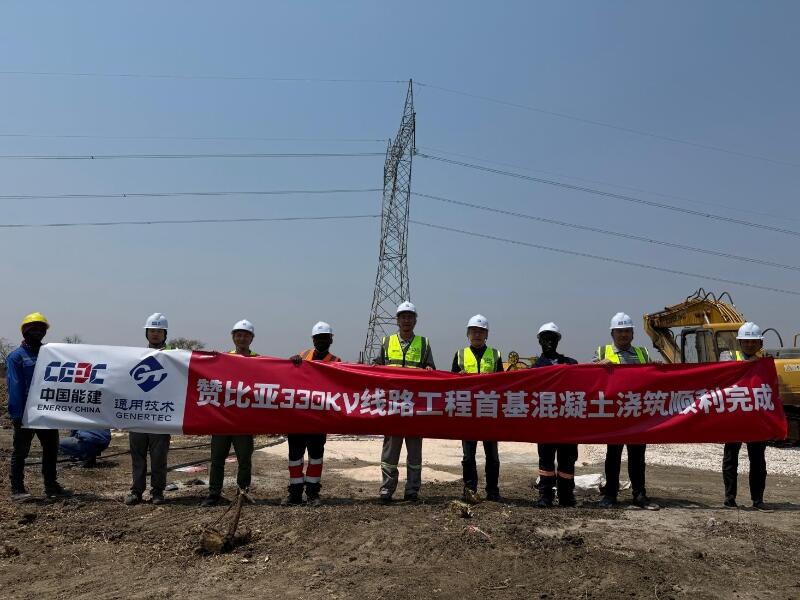
First Foundation Concrete Pour Successfully Completed for Zambia Kafue West–Muzuma 330kV Transmission Line EPC Project
Hot News

评论 (0)