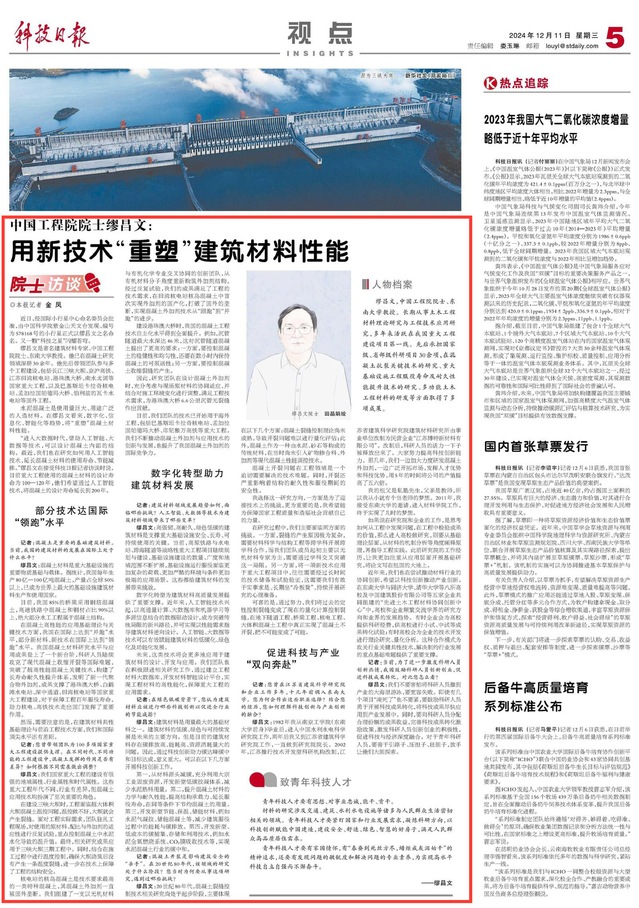

Profile
Miao Changwen is an academician of the Chinese Academy of Engineering and a professor at Southeast University. He has long been engaged in theoretical research on civil engineering materials and research on engineering technology applications, and has been active on the front lines of China's major engineering construction projects for many years. He has undertaken more than 30 national, provincial and ministerial-level scientific research projects, and has achieved numerous results in research on key technologies for concrete crack resistance, research on technologies for extending the service life and improving the durability of major infrastructure projects, and the development of multifunctional civil engineering materials.
Academician Miao Changwen Illustrated by Tian Jingjuan
[Academician Interview]
◎ Our reporter Jin Feng
Recently, with the approval of the naming committee of the International Astronomical Union's Minor Planet Center, asteroid No. 578168, discovered by the Purple Mountain Observatory of the Chinese Academy of Sciences, was officially named after Miao Changwen. Another "star of science and technology" shines in the sky.
Miao Changwen is a renowned building materials expert, an academician of the Chinese Academy of Engineering, and a professor at Southeast University. He has devoted more than 30 years to the field of concrete research. He has led his team to participate in the construction of numerous projects, including the Three Gorges Dam on the Yangtze River, the Beijing-Shanghai High-Speed Railway, the Tianwan Nuclear Power Station in Jiangsu, the Hong Kong-Zhuhai-Macao Bridge, the South-to-North Water Diversion Project and other major national projects, as well as overseas projects such as the Karachi Nuclear Power Plant in Pakistan, the Padma Bridge in Bangladesh, and the Vaca Hydropower Station in Belize.
Cement concrete is a man-made material with enormous usage and a wide range of applications. In Miao Changwen's view, trends such as digitalization, informatization and intelligentization will "reshape" the performance of concrete materials.
"Entering the era of big data, with the help of technologies such as artificial intelligence and big data, we can design the internal structure of concrete. Recently, we have also been studying how to use artificial intelligence technology to extend the service life of concrete materials and save energy and reduce emissions," Miao Changwen said in an interview with a Science and Technology Daily reporter. At present, the design service life of concrete materials used in major projects is 100 to 120 years; they hope that through artificial intelligence technology, the design service life of concrete can be extended to 200 years.
Some technologies have reached the international "leading" level
Reporter: Concrete is an important basic building material. At present, at what level is China's development of building materials internationally?
Miao Changwen: Concrete materials are an important material foundation and carrier for major infrastructure. According to statistics, China produces 8 billion to 10 billion tons of concrete each year, accounting for more than 50% of global output, making it the world's largest producer and user of infrastructure building materials.
At present, 85% of China's bridges use reinforced concrete; concrete and steel account for more than 90% of high-speed railways; and the vast majority of hydraulic engineering structures are concrete structures.
In terms of the applied basic theory and key technologies for high-performance concrete, China has reached the "running abreast" level internationally, and some new materials and new technologies have reached the international "leading" level. China's research level and application achievements in concrete materials have reached a new stage. Researchers have successively overcome international challenges such as shrinkage cracking of modern concrete, made breakthroughs in key technologies for ultra-high-performance concrete, established a system for improving long-life durability, and invented a new generation of polymer admixtures. The results have supported the construction of major national projects such as the Hong Kong-Zhuhai-Macao Bridge, the Baihetan Hydropower Station, the Shenzhen-Zhongshan Link, and the Tianwan Nuclear Power Station, playing an important role in ensuring a century-long service life for projects and helping nuclear power and high-speed rail technologies go global.
However, it should be noted that in terms of common basic theories and frontier engineering technologies for building materials, we still lag behind the international top level.
Reporter: You have led your team to provide support for the construction of more than 100 major national projects. In engineering construction of different eras and different functions, are there differences in the role played by concrete? How do you make adjustments according to different needs?
Miao Changwen: The construction of our country's major projects has strong regional, industry and era attributes. These major projects span different eras and differ by industry, but concrete application technology has played a crucial role in all of them.
During the construction of the Three Gorges Dam, the project faced the problem of temperature control for the concrete of a super-large-volume dam. If temperature control is not done well, cracks will appear in the dam. Facing the actual needs of the project, the team was stationed at the construction site and conducted repeated tests on the adaptability of the raw materials used, the mix proportions and the admixtures, focusing on controlling the temperature rise caused by cement hydration in the concrete. Ultimately, the relevant research results were applied to the third phase of the Three Gorges Dam project. At the same time, combined with temperature control during construction, it was ensured that no thermal cracks occurred after the dam was poured, further technically safeguarding the structural safety of the project.
The nuclear island concrete of a nuclear power plant is a type of special concrete with the highest technical requirements, and its concrete admixtures had long been monopolized by foreign countries. We formed an innovative team with interdisciplinary collaboration between inorganic materials and organic chemistry, and reconstructed the structure of admixtures from the perspective of organic material molecules. After repeated tests, our results met the technical requirements of the project, achieved the first domestic production of admixtures in the nuclear island concrete of the Tianwan Nuclear Power Station, broke the foreign monopoly, and achieved progress in concrete admixture technology from "following" to "running abreast."
During the construction of the Hong Kong-Zhuhai-Macao Bridge, the level of independent concrete engineering technology in China was comprehensively improved. For example, the maximum water depth of the immersed tube tunnel reached 46 meters, which imposed higher requirements on the concrete for the immersed tube tunnel: on the one hand, the stability and uniformity of the concrete had to be controlled, and the pumpability of the concrete had to be maintained for several hours; on the other hand, the occurrence of shrinkage cracks in the concrete had to be controlled.
Therefore, when designing concrete admixtures, the research team fully considered synergistic adaptability with on-site raw materials and made adjustments in light of changes in the construction environment to meet the technical requirements of the project, contributing to the crack-free 6.6-kilometer immersed tube of the Hong Kong-Zhuhai-Macao Bridge.
At present, our team's technology has begun to be used in overseas projects, including major projects such as the Karachi Nuclear Power Plant in Pakistan, the Padma Bridge in Bangladesh, and the Jakarta-Bandung High-Speed Railway in Indonesia. We continue to promote innovation and development in concrete admixtures and application technologies, and have also enhanced the international competitiveness of China's concrete admixtures.
Digital transformation boosts the development of building materials
Reporter: What are the development trends in the field of building materials, and what challenges does it face? What changes have technologies such as artificial intelligence and big data brought to the field of building materials?
Miao Changwen: Building materials with high strength and toughness, high durability, and green and low-carbon characteristics are key to supporting the safe, long-life and sustainable use of major infrastructure. At present, strategic major engineering projects such as plateau railways and hydropower stations, and cross-sea tunnels are being planned and constructed one after another. The number, breadth and geographical scope of infrastructure construction are constantly expanding, and the operation and service of infrastructure are facing more complex loads, harsher environments and more extreme application scenarios. All of these bring challenges to the development of building materials.
Digital transformation provides important support for the high-quality development of building materials. In recent years, artificial intelligence technology has emerged, and data-driven design combining multi-source information such as high-throughput computing, large databases and machine learning has become an emerging path to break through traditional limitations, and can realize reverse design of building materials guided by performance requirements. Technologies such as artificial intelligence and big data can effectively empower the low-carbon, green and functional development of building materials.
In the future, such technologies will be applied more in the design, development and application of building materials. Our team is also actively following up on related research work, establishing a large database of engineering materials and developing an intelligent material design platform to achieve high performance of engineering materials and ensure the application needs of major projects.
Reporter: In the context of green and low-carbon development, what technological innovations do you think building materials should undertake to promote energy conservation and emission reduction across the entire industry?
Miao Changwen: Building materials are among the basic materials with the largest usage. The low-carbon, green and sustainable development of building materials is the main direction for the future. However, current building materials have problems of high carbon emissions, high energy consumption and large resource consumption. Therefore, it is of great significance to use technological innovation to help achieve the carbon peak and carbon neutrality goals. Technological innovation work can be carried out in the following aspects.
First, reduce carbon at the source of materials, make full use of bulk industrial solid waste resources, develop new low-carbon cementitious systems, and reduce the amount of cement clinker used. Second, improve the mechanical and durability properties of concrete materials, increase structural bearing capacity, extend service life, and save the amount of concrete used under the same conditions. Third, develop new energy-saving, thermal insulation and energy storage materials, such as cement aerogels and energy-storage concrete, to reduce energy consumption and carbon emissions during the service life of buildings. Fourth, develop new, low-cost carbon capture, storage and utilization technologies, such as all-oxygen combustion systems for cement and CO2 membrane absorption technology, to achieve carbon neutrality in the cement and concrete industry.
Reporter: Concrete cracking is a "killer" affecting building safety. In the 1980s, at what stage was research in this field? Why did you engage in this research at that time, and what challenges did you encounter?
Miao Changwen: In the 1980s, research related to concrete crack control technology was still in its infancy, mainly reflected in the following aspects: theories of concrete crack control were not yet mature, making it difficult to quantitatively assess cracking problems; in addition, concrete, as a traditional material composed of cement, sand and gravel, had not yet introduced modern concrete performance control technologies such as mineral admixtures and chemical admixtures at that time.
The problem of concrete cracking is a technical challenge urgently in need of solution in the engineering field. At the same time, cracking also seriously affects the durability of structures and safety during service.
I chose this research direction, on the one hand, to meet the technical challenge, and more importantly, because I hoped to contribute my own strength to safeguarding national engineering quality and benefiting society.
In the research process, we mainly faced challenges in two aspects. On the one hand, the causes of cracks are extremely complex, requiring interdisciplinary cooperation between materials science and structural engineering and other fields, while our team members were initially mainly experts in inorganic materials and needed to break through this limitation through interdisciplinary integration. On the other hand, applying a new technology to major engineering projects often requires long-term technical reserves and experimental verification, which requires us to have the psychological preparation to seek truth from facts, to be willing to sit on the "cold bench" for a long time, and to carry out research continuously.
Fortunately, through our efforts, we have transformed crack control from the qualitative control of the past to the quantitative calculation-based control of the present, truly achieving crack-free concrete in underground tunnel projects, bridge projects, nuclear power projects and mass concrete projects, turning the impossible into the possible.
Promoting the "two-way journey" of science and technology and industry
Reporter: You worked for many years at the Jiangsu Research Institute of Building Science and in enterprises, and moved to Southeast University more than ten years ago. Why did you make these career choices? Based on your experience, how do you understand the integration of technological innovation and industrial innovation?
Miao Changwen: After graduating from Nanjing Institute of Technology (the predecessor of Southeast University) in 1982, I entered the China Institute of Water Resources and Hydropower Research. Two years later, I went to work at the Jiangsu Research Institute of Building Science, where I eventually served as president of the institute. In 2002, Jiangsu promoted the restructuring of technology-development-oriented scientific research institutions, and the Building Materials Research Institute of the Jiangsu Research Institute of Building Science was restructured from a public institution into a private enterprise, "Jiangsu Bote New Materials Co., Ltd." After the restructuring, the vitality of scientific researchers was suddenly unleashed. Everyone worked hard to improve their capacity for technological innovation. In those years, while increasing efforts to research and develop concrete admixtures, we also extensively opened up markets, leveraged our talent and technological advantages, and increased the company's output value five or six times in five years.
My grandfather was a private school teacher and my father was a teacher, so I had a dream of becoming a teacher since childhood. In 2011, I accepted an invitation from Southeast University and joined the School of Materials Science and Engineering, finally realizing my childhood dream.
If working at the research institute and in enterprises meant thinking about how to discover problems from engineering and test the value of results in engineering, then entering a university to do research means explaining principles from the level of basic theory, from the perspective of material mechanism analysis, and then guiding engineering practice. My previous work experience at the research institute has made me pay more attention to carrying out basic research from the application level, writing papers on the land of the motherland.
In recent years, we have also been trying to promote collaborative innovation in the materials industry, hoping to use technological innovation to drive industrial innovation. In the "Collaborative Innovation Center for Advanced Civil Engineering Materials," jointly established by Southeast University, Tongji University, Tsinghua University and five other universities as well as five enterprises including China State Construction Engineering Corporation, universities and enterprises frequently exchange views on academic research directions and industry development trends. Sometimes enterprises provide research funding to universities for pilot-scale and intermediate-scale testing and other achievement transformation experiments; sometimes universities conduct theoretical research and quantitative analysis for enterprises' technology development. This cooperation model provides important support for tackling key common technologies in the industry and solving major basic problems that constrain industry development.
Reporter: At present, in order to further stimulate the innovation enthusiasm of scientific researchers, China encourages scientific researchers to innovate and start businesses and promotes the transformation of scientific and technological achievements. What is your view on this?
Miao Changwen: We should not be afraid to push scientific researchers into the ocean of industry to swim, and we should be tolerant of failure. Even if a few projects "drown," it does not matter; we should encourage scientific researchers to courageously carry out the transformation of scientific and technological achievements and apply them to industrial development as soon as possible. At the same time, we should allocate a reasonable share of achievement returns to scientific researchers, improve incentive policies for the transformation of scientific and technological achievements, stimulate the enthusiasm of scientific researchers for innovation and entrepreneurship, and promote the deep integration of science and technology and the economy. For young scientific researchers, we should be good at guiding them, giving them responsibilities, and strengthening their courage, and let them boldly explore.
[To Young Scientific and Technological Talents]
Young scientific and technological talents should be thoughtful, loyal to their cause, capable and willing to work hard.
Research on materials involves many fields closely related to people's lives, such as transportation, construction, and water conservancy and hydropower facilities. Young scientific and technological talents should closely follow the needs of the country and industry development, refine research directions, empower China's construction with technological innovation, build safe, comfortable, green and smart good housing, and meet the people's demand for high-quality housing.
Young scientific and technological talents should have a sense of homeland and national commitment, have the spiritual pursuit of "the spring silkworm spins silk until death, and the candle weeps tears until it turns to ashes," and also have the keenness to discover problems and the professional quality to solve them, and strive unremittingly to achieve high-level scientific and technological self-reliance and self-strengthening.
— Miao Changwen
[Local Society] The Second Youth Academic Forum of the Hunan Provincial Society of Mechanical Engineering Held in Changsha
下一篇Construction Begins on the World's Largest Compressed Air Energy Storage Power Station

2026-09-28 1157 0
2026-09-24 10586 0
2026-09-23 10714 0
2026-09-22 10808 0

Lize City Air Terminal Underground Main Structure Nearing Completion: Maximum Transfer Walk Under 4 Minutes After Operation

Anti-seepage Curtain for Main Lock Pit of CSCEC Port Shenqiu Double-Line Lock Project Completed on Schedule

All Pile Foundations Completed on Quanzhou Baiqi Channel

Hainan Upgrades Housing and Municipal Infrastructure
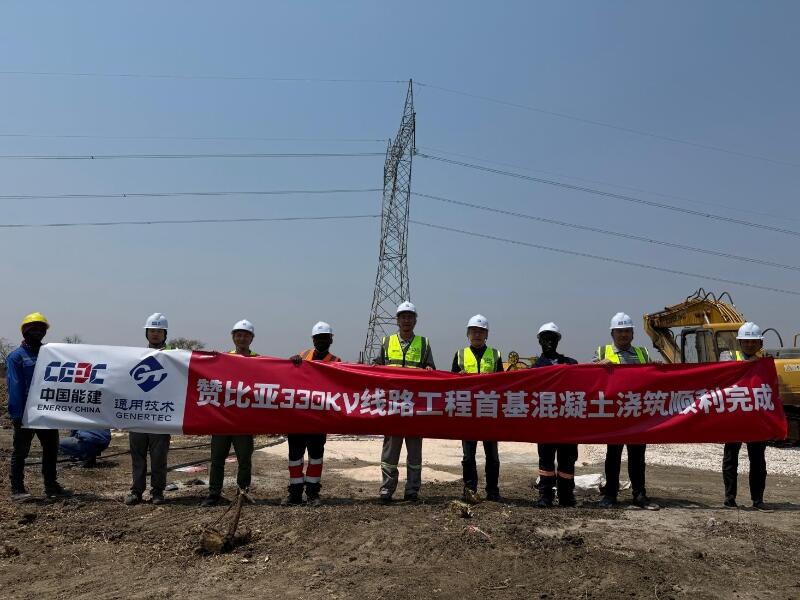
First Foundation Concrete Pour Successfully Completed for Zambia Kafue West–Muzuma 330kV Transmission Line EPC Project
Hot News

评论 (0)