The Yangtze River is the mother river of the Chinese nation. Developing and utilizing the hydropower resources of the Yangtze has been the dream of several generations of Chinese people.
Sailing out of the Three Gorges, one generation used reform as their oars—decision-making and feasibility studies, establishing the "four systems," rolling development... meeting technical, economic, and ecological challenges, and drawing up the blueprint for the project;
Sailing against the current, one generation used innovation as their rudder—phased construction, two river closures, temperature-controlled pouring... tackling difficult problems and building a dam body a thousand meters long.
Standing at the 30th anniversary of the start of construction of the Three Gorges Project, reviewing its construction历程, we seek answers to the questions: Why is innovation the gene of the Three Gorges Project? And where will innovation lead the Three Gorges Project?

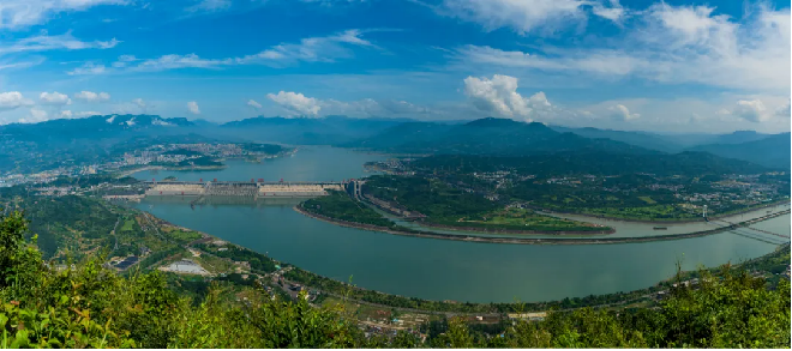
Panoramic view of the Three Gorges Project
Anchoring goals in the channel of history
Reviewing five thousand years of Chinese water management history, from the Zhengguo Canal to Dujiangyan, from the Red Flag Canal to Danjiangkou—although water conservancy projects involving dredging river channels, building dams to store water, and digging canals for irrigation each had their own innovations, most tended toward exploiting a single function of rivers. The Three Gorges Project, by contrast, balances multiple benefits including flood control, ecology, navigation, and energy, making it truly the culmination of innovation in water conservancy engineering.
Opening the map of China's geography, the upper reaches of the Yangtze have abundant runoff; roughly a million square kilometers of river flow carries its surging waters into the Three Gorges, yet it can only rely on a drop of a few dozen meters to travel over a thousand kilometers east to the sea. As the mountains end and the plains begin, the river flows into the vast wilderness; the Jianghan Plain has limited flood storage capacity, and reinforcing embankments has created a "suspended river" overhead. The other side of "when Huguang is ripe, the whole world has enough" is that 15 million people and 23 million mu of fertile farmland have suffered from floods for thousands of years.
Floods strike frequently—when can the predicament of "a vast expanse of water stretching a thousand li" be resolved? When can the footsteps of the hundreds of thousands of people who guard embankments each year in the provinces along the river come to a halt?
In February 1953, Comrade Mao Zedong, on his way from Wuhan to Nanjing aboard the warship "Yangtze," heard Lin Yishan's report on two conceptual plans for Yangtze flood control. Afterwards, Mao Zedong said: "Why not block it at this main junction, accomplish the whole task in one campaign, and first build that Three Gorges Reservoir?"
Seizing the throat to control floods, subduing the "beast" so the people need not worry. As Lu Youmei, academician of the Chinese Academy of Engineering and then general manager of the China Yangtze Three Gorges Project Development Corporation (the "Three Gorges Corporation"), said, only a relatively stable Yangtze can support humanity's sustainable development. And a modernization of harmonious coexistence between humanity and nature is precisely an important connotation of Chinese-style modernization.
Taking initiative amid the surging market tide
On April 3, 1992, the Fifth Session of the Seventh National People's Congress voted to adopt the "Resolution on Building the Yangtze Three Gorges Project."
A Xinhua News Agency report recorded such a scene: "Amid the applause, many people shed tears of excitement. Amid the applause, people knew that in the young history of the Republic, this was the first time its highest organ of state power had made a decision specifically on a certain construction project. It meant that a dream the Chinese people had dreamed for 70 years would become reality in the not-too-distant future..."
Reform and opening up brought emancipation of thought and a breaking of ice in action, giving rise to innovations in the Three Gorges Project's institutional mechanisms, management models, and other fields; with numerous "Three Gorges systems" innovations, it enriched the practice and theory of our country's "project governance"—
The "four systems" were established, clarifying the responsible entities. Institutional design must adapt to the changes of the times and keep pace with them.
In January 1993, the State Council established the Three Gorges Project Construction Committee of the State Council, representing the national level in decision-making and macro-control over major issues in the construction of the Three Gorges Project. In September 1993, the State Council approved the establishment of the Three Gorges Corporation, determining that the project construction and operation would be organized according to market principles. This model rationalized the relationship of "government-regulated management, independent enterprise operation, and market allocation of resources," forming a new model for the management system of major public works construction in China.
At the very start of the Three Gorges Project, four major management mechanisms were adopted—the project legal person responsibility system, the bidding and contracting system, the construction supervision system, and the contract management system—opening a new chapter in the management of modern water conservancy project construction in China and casting a "stone to test the way" for the reform of China's project construction management system. Subsequently, laws and regulations such as the Construction Law, the Contract Law, and the Bidding Law were promulgated one after another; the legal standards of the "four systems" in project construction management became clearer, and a nationwide project construction market accelerated its formation.
The "three phases" as steps, innovating the investment and financing model. Facing the Three Gorges Project—the largest investment project since the founding of New China—many experts and scholars worried that "national strength could not sustain it." But in the view of Li Yong'an, then general manager of the Three Gorges Corporation, the construction of the Three Gorges Project was precisely an important opportunity to change the single state-investment pattern and explore combining the construction of large public projects with the capital market.
Taking the three construction phases of the Three Gorges Project as steps, financing was innovated in each. Before the main river closure, construction risks were high and financing needs great; state capital injection and policy bank loans solved the initial difficulties. After the main river closure, project risks dropped substantially; the share of market financing was increased and the financing structure optimized. After the first units were commissioned and began generating power, the project's comprehensive benefits gradually became evident; with equity financing channels and capital operations as the vehicle, diversified financing channels were opened up.
Governance has its structure; management standards were improved. Budget management, efficiency management, and quality management of the Three Gorges Project were intertwined; only with structured governance and orderly administration could the ability to steer a mega-project be enhanced.
Establishing the investment management model of "static control, dynamic management; total volume control, reasonable adjustment" effectively controlled the investment estimate and improved investment results; pioneering the "double zero" management concept of "zero quality defects" and "zero safety accidents," and establishing a four-level quality management organization—self-inspection by construction units, overall gatekeeping by supervision units, direct supervision by the owner's project department, and special responsibility by the quality director—which powerfully guaranteed project construction quality; developing the Three Gorges Project Management System (TGPMS), which supports collaborative work among designers, contractors, supervisors, and the owner and realizes full-process information control and management, and establishing 135 Three Gorges Project quality and technical standards, powerfully promoting the Three Gorges Project's construction toward a world-class level.
Competition, efficiency, rules, science... Born amid the vigorous atmosphere of reform and opening up, the Three Gorges Project sought institutional and mechanistic change with new keywords, fully tapped investment space, and tempered its ability to control the project—profoundly proving that the Three Gorges Project was established in the logic of historical progress and built in the tide of the times' development.
Steering steadily and far through shoals and reefs
In the autumn of 1996, a road ran through the Three Gorges dam area, tunneling through mountains and bridging waters, connecting Zhongbao Island in the ancient Xiling Gorge to the "fast lane" of the times' development.
Along this road, how many technical drawings and standard plans accumulated from tiny amounts into great achievements; how many unit components and cement raw materials piled up like mountains. Builders overcame world-class difficulties such as three-phase diversion, variable-head units, and complex dam bodies, and with the knowledge achievements of more than 100 world records and 934 invention patents, built the world's largest water conservancy hub project, the world's largest ship lock, the world's largest and most technically difficult ship lift, and the world's largest and most technically complex AC/DC hybrid transmission system, expanding the development axis and innovation scale of the world's hydropower coordinate system.
Pooling strength, integrated innovation. Main river closure—the closure water depth was the world's greatest; the closure flow ranked first among the world's closure projects; the dumping intensity during closure ranked first in the world. Pan Jiazheng, academician of both the Chinese Academy of Sciences and the Chinese Academy of Engineering, once remarked, "Looking through the history of major river closure projects in the world, a situation combining so many difficulties is indeed rare; the main river closure and the second-phase cofferdam are truly projects surpassing international levels."

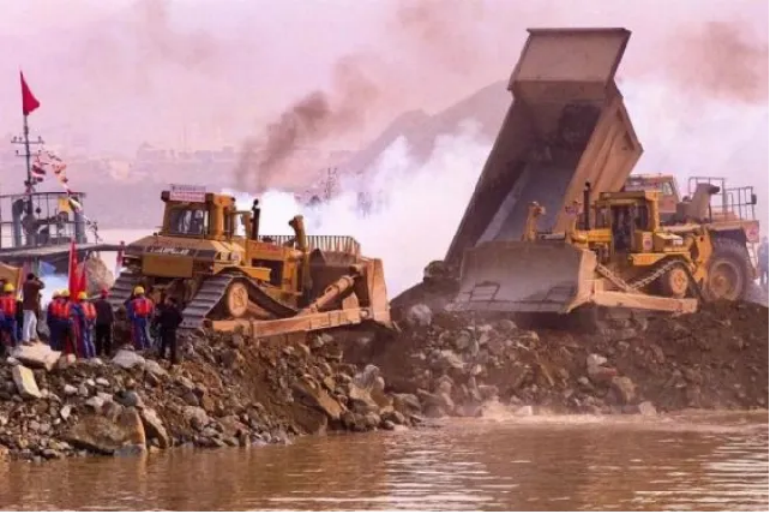
In 1997, as the last truckload of stone was tipped into the river, the Three Gorges Project victoriously achieved the main river closure
Facing this complex problem, researchers integrated existing external knowledge or technology, combining hydraulics, geotechnical mechanics, metal structures, environmental science, and other disciplines to carry out a series of research attacks on safety technical measures, model tests, surveying and monitoring, and construction management information. Builders creatively adopted the construction scheme of "pre-leveling and bottom-dumping, upstream single-dike vertical closure, two-way advancement, and downstream trailing advancement," solving the technical problem of deep-water closure; during the closure period they used high-tech hydrological forecasting, using hydrological information and a self-developed three-dimensional model of main river closure to provide technical support for expanding diversion and other matters; through information tracking and dynamic decision-making, they continuously strengthened construction organization and management; and they deepened engineering practice into theory, studying the causes and mechanisms of collapse at the closure dike head in deep water and proposing for the first time new concepts and new problems concerning the degree of difficulty of deep-water closure.
Behind this, Zheng Shouren, academician of the Chinese Academy of Engineering and chief design engineer of the Three Gorges water conservancy hub project, pooled the strength of professional and technical personnel to tackle the problems; in the laboratory, large numbers of hydraulic model tests, numerical calculations, and mechanism analyses were repeatedly measured and calculated; at the project site, all construction parties communicated fully, technical discussion meetings were held at any time, and water conservancy experts helped offer ideas... The integrated innovation model also spread from the Yangtze to the four cascade hydropower stations on the Jinsha River and to offshore wind power construction sites, continuing to play out on the stage of rivers and seas.
Creating platforms, targeted innovation. On the right bank of the Three Gorges Dam, the "TEREX LDC-6 side-dump concrete transport vehicle" custom-built by North Heavy Truck Company for the Three Gorges Project had internationally leading technical performance indicators and was subsequently applied at many water conservancy and mining sites; in the Three Gorges power station, a project team composed of units including the Ansteel Technology Center and the New Rolling Steel Co., Ltd. used unconventional innovation to advance the development of steel plates for Three Gorges spiral cases, achieving a beautiful "first leap" in the "triple jump" of Chinese hydropower steel plates at 600, 800, and 1,000 MPa.
In customized scenarios, the industrial chain and the innovation chain are deeply integrated; innovation entities persist in targeted research, customized innovation, and positioned breakthroughs, and a batch of "Three Gorges firsts" technologies achieved "overtaking on the curve."
Innovation achievements, widely shared. In Beijing in 1996, a bright red banner reading "International Bidding Conference for Water Turbine Generator Units of the Three Gorges Project Left Bank Power Station" attracted the attention of hydropower practitioners from all over the world. Through bidding, the 14 units on the left bank of the Three Gorges achieved Sino-foreign joint design and cooperative manufacturing; from the left bank to the right bank of the Three Gorges Dam, Chinese enterprises successively obtained more than 100 technical patents, and China leapfrogged a 30-year gap with advanced foreign technology.


Left bank powerhouse of the Three Gorges power station
At present, among the 127 water turbine generator units of 700,000 kilowatts and above already built or under construction worldwide, the Three Gorges Corporation manages 86; one after another Three Gorges technology and standard, through industrial chain extension, develop cyclically in the model of "science-technology-engineering-industry," promoting the common progress of the world's hydropower units.
On November 8, 1997, the Yangtze Three Gorges water conservancy hub project successfully achieved the main river closure. On July 4, 2012, the last 700,000-kilowatt giant unit of the Three Gorges Project was officially delivered and put into operation.
The so-called "great power heavy equipment" is not only achievements, platforms, models, and standards, but also a country's confidence in innovation. What the Three Gorges Project reflects is precisely our country's leap, amid tremendous changes in world and national conditions, in water management philosophy from partial to systemic, in project organization from planned to market, and in technological innovation from catching up to surpassing and then to leading.
The river surges on, with twists and obstacles, and also with magnificent waves. Today's "Three Gorges," persevering tirelessly on the path of innovation, is striving to write a new chapter of Chinese-style modernization.
Providing Green Clean Energy and Opening Up the Hanjiang Golden Waterway
下一篇Yunnan's New Infrastructure Project and 'Double Ten' Key Infrastructure Initiative: International Supply Chain Demonstration Center to Debut in Kunming

2026-10-18 0 0

2026-10-18 0 0

2026-10-17 0 0

2026-09-23 10598 0
Lize City Air Terminal Underground Main Structure Nearing Completion: Maximum Transfer Walk Under 4 Minutes After Operation
Anti-seepage Curtain for Main Lock Pit of CSCEC Port Shenqiu Double-Line Lock Project Completed on Schedule
All Pile Foundations Completed on Quanzhou Baiqi Channel

Hainan Upgrades Housing and Municipal Infrastructure

First Foundation Concrete Pour Successfully Completed for Zambia Kafue West–Muzuma 330kV Transmission Line EPC Project
Hot News

评论 (0)