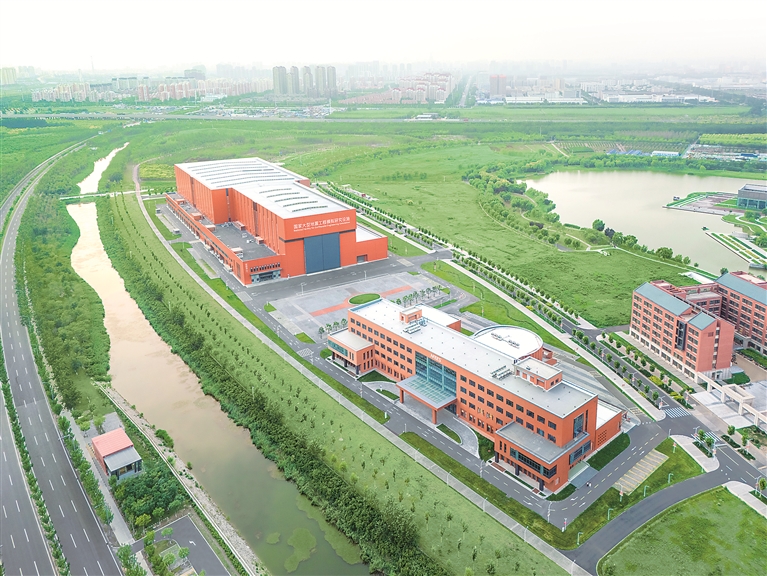
Aerial view of the large seismic facility. Photo courtesy of Tianjin University
Researchers input seismic parameters into the console; power begins to transmit through the oil pumps, and 46 actuators generate a combined thrust as a seismic engineering simulation test officially begins... In the control room of the Experimental Center of the Large-Scale Seismic Engineering Simulation Research Facility (hereinafter referred to as the "large seismic facility") located on the Peiyang Campus of Tianjin University, researchers are conducting intensive tests on a newly designed building model.
Not long ago, China's first major national science and technology infrastructure in the field of seismic engineering—the Large-Scale Seismic Engineering Simulation Research Facility—passed national acceptance at Tianjin University and was put into operation. The large seismic facility is equipped with the seismic simulation shaking table with the largest table size and load capacity in the world today, as well as the world's first movable underwater shaking table array, and can observe and analyze the damage to engineering structures during earthquakes.
What test conditions are required to carry out a seismic engineering simulation test? What help will the commissioning of the large seismic facility bring to earthquake prevention and disaster reduction efforts? Please join the reporter in visiting China's first major national science and technology infrastructure in the field of seismic engineering.
Studying the seismic performance of engineering structures to better meet the major needs of public safety and engineering construction
To do a good job, one must first sharpen one's tools. At present, a new wave of scientific and technological revolution is surging, full of opportunities and challenges. Major national science and technology infrastructure, known as "large scientific facilities," are precisely the national heavy weapons that drive major scientific and technological innovation. They can provide contemporary scientists with extreme research means to explore the unknown world, discover natural laws, and achieve technological transformation, and are the material and technical foundation for breaking through the frontiers of science and solving major scientific and technological problems in economic and social development and national security.
From the Beijing Electron-Positron Collider to the "China Sky Eye" in Guizhou, from the Lanzhou Heavy Ion Accelerator to the "Kuafu" experimental device for the "artificial sun," as of now, China has planned and built 77 major national science and technology infrastructure projects, covering multiple fields such as physics, materials science, and life sciences.
"Most of the large scientific facilities built so far take theoretical science as their research object, such as astronomy and high-energy physics, and lean more toward basic theory. The large seismic facility, however, is a science and technology infrastructure in engineering science, specifically studying the seismic performance of engineering structures during earthquakes—simply put, studying what kind of damage various engineering projects may suffer during earthquakes," Liu Mingjie, Director of the Science and Technology Process Department of the Construction Office of the Large-Scale Seismic Engineering Simulation Research Facility at Tianjin University, told the reporter.
With social development, there are more and more major projects in fields such as water conservancy, civil engineering, marine engineering, transportation, and energy. China is located at the intersection of the world's two major seismic belts—the Circum-Pacific seismic belt and the Eurasian seismic belt—and has a high frequency and high intensity of seismic activity, making it one of the countries most severely threatened by earthquakes in the world. The failure and damage of engineering structures are important causes of casualties, property losses, and impeded development during earthquakes.
Identifying the weak links in the seismic resistance of engineering structures and improving their ability to resist earthquake damage in a targeted manner is an important measure for earthquake prevention and disaster reduction.

Full-scale steel frame test on the large seismic simulation shaking table. Photo courtesy of Tianjin University
Liu Mingjie introduced that research methods in seismic engineering mainly include theoretical analysis, experimental research, and numerical simulation, but when an earthquake actually occurs, there are often unexpected situations. Therefore, vibration simulation, i.e., "artificial earthquakes," is currently the most direct and effective experimental method for studying the seismic performance of engineering structures. However, previously existing seismic simulation shaking tables at home and abroad were difficult to meet the major needs of public safety and engineering construction due to their small scale or single test functions.
After more than a hundred rounds of demonstration, Tianjin University launched the construction of the large seismic facility in October 2019. The total building area of the large seismic facility is 76,000 square meters, mainly including two individual buildings—the Experimental Center and the Simulation Center. Among them, the Experimental Center mainly conducts seismic engineering simulation experimental research, while the Simulation Center mainly conducts numerical computation, visual simulation, and other work. The large seismic facility can observe the damage and destruction of engineering structures during earthquakes and help improve the seismic resistance of engineering structures.
Larger test scale and higher precision, enabling joint simulation of underwater dual-table earthquakes, waves, and currents
Walking into the Experimental Center of the large seismic facility, the most intuitive impression is that this is a huge space. The indoor clear height is 31 meters, equivalent to the height of a nine-story building. In the area of the large seismic simulation shaking table, there are two double-girder bridge cranes with a lifting capacity of 500 tons and a span of 42 meters, which can meet the needs of transporting and installing large-scale test models.
In the entire facility, the core parts are the large seismic simulation shaking table and the underwater shaking table array located in the Experimental Center.
Zhu Ran, Deputy Director of the Construction Office of the Large-Scale Seismic Engineering Simulation Research Facility at Tianjin University, introduced that the foundation of the large seismic simulation shaking table is buried 18 meters deep, and it is currently the shaking table with the largest table size and load capacity in the world. The table is 20 meters long and 16 meters wide, with a maximum load capacity of 1,350 tons, roughly equivalent to the weight of more than 20 heavy-duty trucks when fully loaded.
When conducting model tests, the closer the model size is to the real project, the more accurate the test results tend to be. In the past, limited by the size and load capacity of shaking tables, seismic performance tests could only scale down buildings and other structures proportionally. This large seismic simulation shaking table, however, can restore a seven-story building at a 1:1 ratio. Letting a building experience a real earthquake allows its most realistic vibration response to be obtained, which is of great research value for improving the seismic performance of engineering structures in earthquake-prone areas.
During the test process, how does the large seismic simulation shaking table work specifically?
"We have placed 46 actuators beneath the table. During tests, the actuators can simulate seismic motion in the horizontal and vertical directions, affecting the structural model under test placed on the table, and then precise vibration response data are obtained through sensors on the table and surrounding cameras. Using these measured data, researchers can develop more targeted methods for improving seismic performance," Zhu Ran said, noting that the sensors used in the tests are extremely precise—for example, the sensor measuring structural deformation has a minimum measurement value of 0.1 millimeters.
On the other side of the Experimental Center, the underwater shaking table array and wave- and current-generating equipment are arranged in a large pool 95 meters long and 69 meters wide. This is currently the world's only test device capable of jointly simulating underwater dual-table earthquakes, waves, and currents, and it can operate at a water depth of 3 meters. Wave- and current-generating equipment is installed on both sides of the pool, with wave heights reaching up to 0.5 meters, providing a test environment for water-related super projects such as cross-sea bridges, subsea tunnels, hydraulic dams, and offshore wind power, thereby supporting engineering construction.
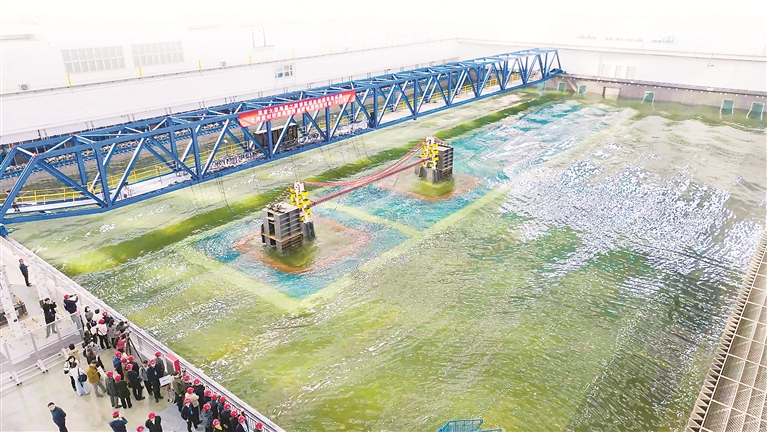
Suspension bridge test on the underwater shaking table. Photo courtesy of Tianjin University
In the future, the large seismic facility will conduct physical experiments through the seismic engineering simulation test system while restoring seismic data through the high-performance computing and intelligent simulation system, promoting the shift from post-disaster relief to pre-disaster prevention.
Zhu Ran introduced: "In addition to the two major physicaltestplatforms in the Experimental Center, we have also equipped the Simulation Center with high-performance computing and visual intelligent simulation equipment to extend the research. The visual intelligent simulation equipment can realize real-time digital twin modeling of the test process, help researchers perceive the test progress more effectively, and enable comprehensive integrated management of test data and simulation data, big data analysis, and open sharing."
It can not only simulate and verify individual engineering projects, but also help research on key scientific issues in the field of seismic engineering
Since the Large-Scale Seismic Engineering Simulation Research Facility was officially completed, the project team has received "orders" from many companies and units in domestic industries such as construction, transportation, and energy.
"These test needs are all one-on-one and customized. For example, if a certain unit wants to build a cross-sea bridge, it can provide us in advance with the relevant design drawings or a scale model, and we use the large seismic facility to conduct simulation tests on the parts that need to be tested. In this process, it is possible to identify which designs can still be optimized and improved, thereby ensuring building safety while also enhancing the economic efficiency of its construction," Liu Mingjie said.
It is understood that the project team has more than 50 researchers in total. For scientific workers striving on the front line of seismic research, the large seismic facility is not only an experimental facility but also an object of their research; its construction, operation, and testing will generate many research topics.
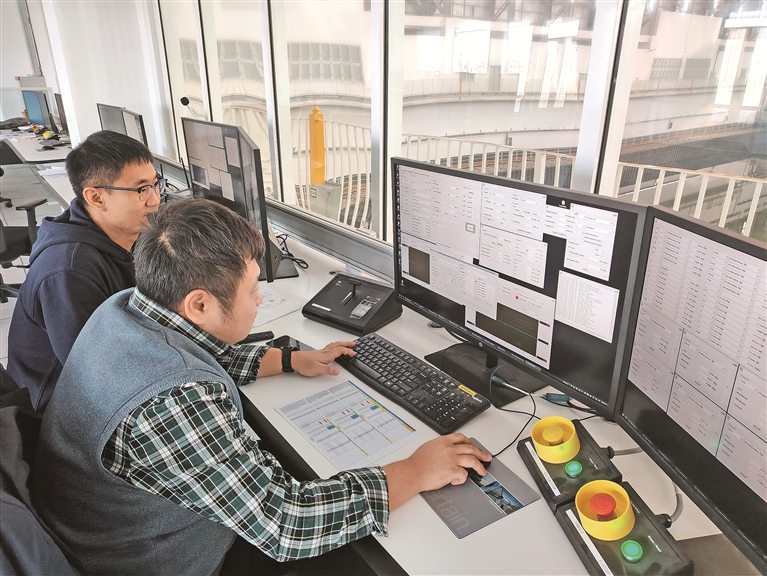
Researchers operating the shaking table system in the control room. Photo courtesy of Tianjin University
The design and construction process is also a process of tackling key engineering and technological challenges. For two large pieces of equipment to operate safely, precisely, and efficiently within a foundation more than 10 meters underground, more than 7,000 process equipment embedded parts are required, with the largest single embedded part weighing more than 10 tons and an installation error of no more than ±1 millimeter. The construction team of the large seismic facility has successively overcome more than 40 important technical difficulties. At present, it has successfully completed the civil engineering construction and the installation and commissioning of process equipment, and has passed all special acceptance inspections—for construction and installation engineering, process performance, fixed assets, financial management, and project archives—as well as national acceptance.
After being officially put into use, the role of the large seismic facility lies not only in verifying individual engineering projects, but also in helping research on key scientific issues in the field of seismic engineering.
Not all projects require simulation tests using the large seismic facility. To ensure their seismic performance, a mature and standardized engineering construction standard is key.
Liu Mingjie told the reporter: "We have designed quite a few models ourselves, hoping to use a series of tests with this facility to extract scientific results and then turn those scientific results into engineering industry standards, thereby improving the design, construction, and operation and maintenance capabilities of the entire industry and supporting society-wide earthquake prevention and disaster reduction efforts."
To simulate strong earthquakes again and again, the facility itself also becomes a huge vibration source. During tests, how can the impact on daily teaching and life on campus and on surrounding municipal projects such as subways be reduced?
"Starting from site selection, the project team has done a great deal of research in this regard. Through theoretical research, simulation analysis, and actual measurements during equipment operation, we have proposed theories and control methods for vibration impact analysis to ensure that measured vibration values in surrounding areas meet regulatory requirements and to ensure a safe and comfortable environment on campus and in surrounding areas. To solve the problem of vibration inside the laboratory building, we have proposed semi-active three-dimensional vibration isolation technology and used this technology to reduce vibration at key locations, ensuring safety inside the building," Zhu Ran said.
DUT Students Achieve Outstanding Results at the National Finals of the China University Student Mechanical Engineering Innovation and Creativity Competition (Intelligent Precision Assembly Category)
下一篇Shanghai Electric Power Construction Wins Two Consecutive LNG Construction Projects

2026-10-14 0 0
2026-09-28 36 0
2026-09-22 10749 0

2026-09-18 11026 0

Lize City Air Terminal Underground Main Structure Nearing Completion: Maximum Transfer Walk Under 4 Minutes After Operation

Anti-seepage Curtain for Main Lock Pit of CSCEC Port Shenqiu Double-Line Lock Project Completed on Schedule

All Pile Foundations Completed on Quanzhou Baiqi Channel
Hainan Upgrades Housing and Municipal Infrastructure
First Foundation Concrete Pour Successfully Completed for Zambia Kafue West–Muzuma 330kV Transmission Line EPC Project
Hot News

评论 (0)