In the 14th "Challenge Cup" Qinchuangyuan China College Students' Entrepreneurship Plan Competition, the "Sea-Probing Divine Needle" team, composed of Ding Xiaodan (2024 graduate student in Environmental Geological Engineering), Ma Haipeng (2023 graduate student in Environmental Geological Engineering), Wang Wentao (2022 graduate student in Environmental Geological Engineering), and Ma Kun (2022 graduate student in Geotechnical Engineering) from the School of Environmental Science and Engineering, together with teacher Zhang Minsheng and others as advisors, returned with honors.
With their project "Sea-Probing Divine Needle — A Leader in Deep-Sea Geotechnical Investigation Equipment for Building a Maritime Power," they won the gold award in one stroke, achieving the university's first national gold in this competition in sixteen years.

From left to right: Zhang Minsheng, Shi Zhenhua, Zhou Lingling, Ding Xiaodan, Ma Kun, Tian Lin, Luan Lubao, Li Sitong, Ma Haipeng
Breaking conventions and innovating
Traditional marine geotechnical investigation tools use a motor drive to push a probe rod uniformly into the seabed soil layer. The force sensor mounted on the probe, like a keen antenna, captures the subtle changes in soil resistance, thereby revealing the secrets of soil bearing capacity.
However, as China's maritime power construction continues to advance into deep and distant seas, problems with traditional equipment—such as heavy weight, difficult installation, high transportation costs, and long installation times—have become increasingly prominent.

Traditional marine geotechnical investigation tools
Facing this challenge, the "Sea-Probing Divine Needle" team proposed a bold idea: remove the motor and use gravity to "throw" the probe rod from the sea surface down to the seabed, penetrating into the seabed strata like a needle. Through this improvement, efficient and rapid testing can be achieved, supporting China's deep-sea engineering construction and meeting engineering needs in special scenarios.
However, the path of innovation is not always smooth. According to the design principle, the "Sea-Probing Divine Needle" falls freely to the seabed surface with a very high initial penetration velocity, and the velocity during penetration changes with penetration time. Data processing methods derived from traditional uniform penetration are no longer applicable. How to interpret the data collected by the free-fall penetrometer became the first challenge the team faced.

"Sea-Probing Divine Needle" equipment
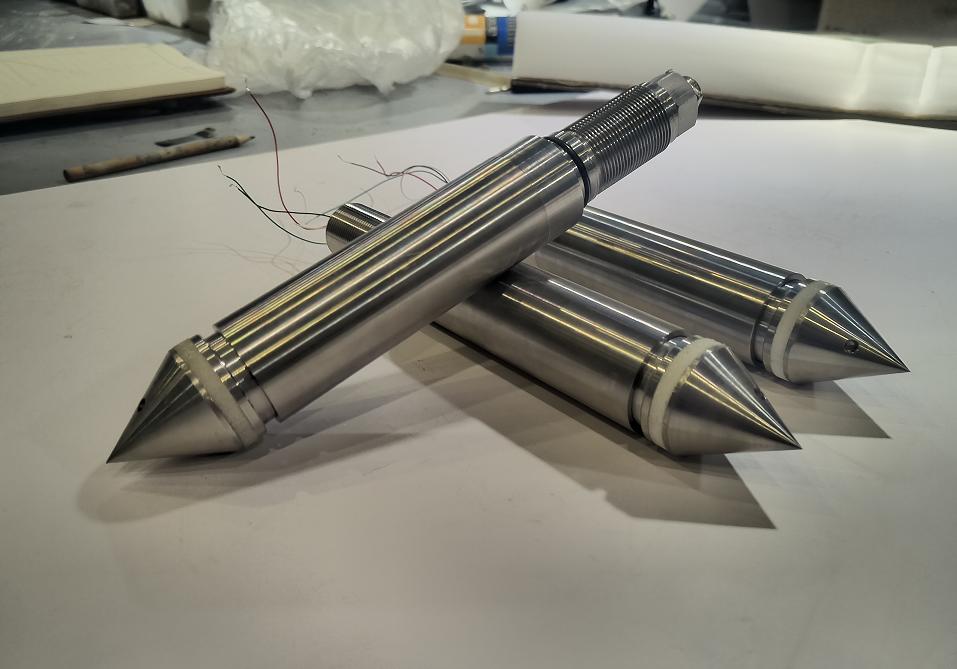
Actual "Sea-Probing Divine Needle" probe
Facing this challenge, they rose to the occasion. The team adopted a completely new method: "theory determines the relationship, experiments determine the coefficients." This method not only greatly improved work efficiency but also made exploration results more accurate and reliable.
In addition, the soft seabed soil interface encountered in product testing caused unclear water-soil interface identification, which also brought considerable trouble to the development and promotion of the equipment. The surface sediments of soft seabed soil are loose, and resistance changes are not obvious. Relying on traditional sudden changes in mechanical parameters cannot accurately determine the equipment's soil entry time, resulting in a mismatch between bearing capacity and stratum depth.
To solve this problem, the "Sea-Probing Divine Needle" team introduced an optical method. By monitoring changes in optical parameters such as turbidity and brightness before and after soil entry, they successfully reduced the soil entry point error to the centimeter level. This innovation improved exploration accuracy and efficiency, providing a more solid guarantee for offshore engineering.
In this competition, they went through six years of technical research and three iterations of upgrades. They tackled the pain points of free-fall penetration testing one by one, developed a complete analytical theory, and solved specific practical problems such as difficult data interpretation and difficult depth measurement, laying the foundation for the development and promotion of high-end marine equipment.
Prudent to the end as at the beginning, persevering without stopping
The process of establishing theoretical connections was not smooth. The team's early projects focused mainly on laboratory experiments.
Ma Haipeng, who was responsible for the experiments, said: "What we did were all original experiments, and the devices were mainly designed by ourselves." Therefore, they encountered two major difficulties during the experiments: abnormal experimental data and long experimental cycles.
When new equipment faced unexpected situations, the data could not be reasonably explained, so continuous debugging was needed during the experiments. Clay drains slowly; only one experiment could be done per month, and only four items at a time. If any one of the four went wrong, the time was wasted, making the overall time cost very "expensive."
Problems kept arising during the experiments, and while summarizing lessons, they also continuously upgraded the equipment. The initial sealing rings were made of rubber, but later they found that rubber did not have good ductility, so they changed the sealing ring material to silicone. They strove for perfection, constantly adjusting to obtain more precise data.
"After revising the application materials, it was already dawn. Pulling all-nighters was something almost everyone had to go through," said Wang Wentao. Their advisor Zhang Minsheng had great expectations for their project and was very strict. Encouraged by their teacher, they established their own work system based on the actual application needs of the market.
"Wherever something was not done well enough, we would discuss that problem, and often one discussion would last several evenings." Disagreements within the team were also commonplace.
Ding Xiaodan said: "In the process of pushing things forward, there are always many forks in the road, and everyone has their own ideas. This is normal." Facing difficulties and challenges, they actively coordinated and pooled their wisdom, resolving disagreements through consultation and critical thinking, ultimately gathering everyone's intelligence and delivering satisfactory results.

Team members discussing
"As the defender, I was actually very nervous, but I rarely told them that," said Ma Kun. Standing before the audience carrying the expectations of the whole team, Ma Kun actually felt great pressure. But when he began presenting the company's achievements and data, he suddenly felt confident.
"These are our existing cooperation cases. Our equipment has already been used in wind farm construction in Shandong and Fujian." Behind these simple words were three years of hard struggle.
To bring their startup to the market, three science students who knew nothing about running a company began setting up their own business. "At first, we didn't even know how to apply for an account or register a company," said Wang Wentao.
Initially, due to tight funds, they did not even hire an accountant, and they learned to read financial expenditure statements through their own exploration. They were even more lacking in professional company knowledge. Through continuous learning, they grew rapidly, finalizing their first cooperation within a year, then the second, the third...
At the competition, they confidently presented their company's relevant data and information, because beneath the data were the cooperations they had secured through tremendous effort and the crystallization of three years of hard work.
Six years of preparation, success after many trials
"Because we were well prepared, we did not encounter major difficulties in the competition," said Ding Xiaodan. Behind the seemingly smooth competition process were six years of polishing and persistence.
Team founder Ma Kun recalled that this long journey actually began in 2018.
During their undergraduate years, they were not advantaged in competitions due to a lack of practical experience. In their early learning and exploration, they did relatively simple work, and the team did not achieve very good results. But it was during this difficult bottleneck period that they continuously accumulated experience and gradually developed the ability to take charge independently.
In 2021, the team reached its first turning point. At that time, Ma Kun and Wang Wentao were juniors, bearing academic pressure and facing choices at a crossroads in life. Although Wang Wentao was preparing for graduate school, after Ma Kun decided to participate in the 10th National Aircraft Design and Manufacturing Competition, he resolutely chose to overcome difficulties together with the team.
"At that time, many people could not hold on and dropped out," said Ma Kun. "If you encounter something bad on your life path and you stop, that bad thing may remain just a bad thing forever. But if you get through it, only then does the bad thing have the possibility of becoming a good thing."
After three years of lying low, they began to show their talents, and ultimately won the national special prize in this competition. They then pressed on and won the national silver award in the "Internet+" College Students' Innovation and Entrepreneurship Competition, achieving a breakthrough for the university in the main undergraduate track.

Participating in the "Internet+" College Students' Innovation and Entrepreneurship Competition (from left to right: Ma Haipeng, Ding Xiaodan, Ma Kun, Wang Wentao)
The national silver award did not become a shackle on their honors but rather fuel that pushed the team to start a new journey. With a mindset of unwillingness to give up and refusal to admit defeat, the team set sail again.
In 2022, they officially began their journey to the national competition. They overcame obstacles all the way, with teachers and friends escorting them. Preparing materials, organizing texts, reporting and defending. Ding Xiaodan said, "Along the way, I am very grateful for the strong support given to us by the university and the college, grateful to teacher Zhang Minsheng for his guidance and help during preparation and the competition, grateful to advisor Professor Wang Dong for supporting the team's innovation and entrepreneurship activities, and grateful to the national entrepreneurship training project and the 'Chunhua' Scholarship for their help during our entrepreneurial development stage, as well as the guidance from the University Student Entrepreneurship Incubation Center and the Innovation Education Practice Center."
From laboratory experiments to devices and equipment, from theoretical study to founding a company. This team supported one another and passed the torch from cohort to cohort. "New team members are also working hard." The story of the "Sea-Probing Divine Needle" is not over, and the story of Ocean University students continues.

Competition trophy
Over these six years, they always stayed on the front line of innovation and entrepreneurship. The national gold award, coming sixteen years later, was by no means accidental. This journey full of passion and struggle finally came to a圆满 conclusion when they won the gold. At the moment they stepped onto the national competition stage, every step they had taken over the past six years counted.

From left to right: Zhang Minsheng, Shi Zhenhua, Ma Kun, Ding Xiaodan, Lu Hehe, Liu Hui
Full-span breakthrough! A batch of Fujian transportation engineering projects refresh their progress bars
下一篇This Winter, One More Degree of "Power Construction Warmth"

2026-09-28 1157 0

2026-09-24 10586 0

2026-09-23 10714 0

2026-09-22 10808 0

Lize City Air Terminal Underground Main Structure Nearing Completion: Maximum Transfer Walk Under 4 Minutes After Operation

Anti-seepage Curtain for Main Lock Pit of CSCEC Port Shenqiu Double-Line Lock Project Completed on Schedule

All Pile Foundations Completed on Quanzhou Baiqi Channel

Hainan Upgrades Housing and Municipal Infrastructure

First Foundation Concrete Pour Successfully Completed for Zambia Kafue West–Muzuma 330kV Transmission Line EPC Project
Hot News

评论 (0)