When water conservancy thrives, the world is stable. This year, Jiangsu has comprehensively accelerated the construction of the main skeleton and major arteries of the national water network, promoting a batch of key projects to be built, a batch to be started, and a batch to be reserved, fully leveraging water conservancy's role in stabilizing investment and growth, and becoming a "strong engine" driving economic recovery and improvement.
The reporter learned from the Provincial Department of Water Resources that as of mid-November, the province's key water conservancy projects had completed a cumulative investment of 19.08 billion yuan, accounting for 90.9% of the annual target. Winter and spring are the golden period for water conservancy construction. Recently, the reporter visited key project construction sites one after another to experience firsthand the upsurge of accelerated advancement of these major national projects.
Safeguarding water security, serving high-quality integrated development of the Yangtze River Delta
The Wusong River (Jiangsu Section) Regulation Project is a key backbone project of the 14th Five-Year Plan for improving the flood control engineering system of the Taihu Lake Basin and accelerating the construction of the national water network. The Jiangsu Section of the Wusong River Regulation Project is located within Suzhou City, with a total investment of 15.89 billion yuan. The regulation project mainly includes river channel regulation, supporting expansion of water conservancy hubs, new and reconstructed cross-river bridges, and water system impact adjustments.
After the Start of Winter, the reporter came to the Jiepu Port Large-Span Sluice project site at the confluence of Jiepu Port and the Wusong River in Suzhou Industrial Park and saw tall tower cranes and a scene of bustling activity. "After the project is completed, it will become the third flood discharge channel of Taihu Lake, expanding the scale of eastward discharge of the Taihu Lake Basin into the sea, while also enhancing water resource allocation capacity," said Wang Wei, deputy director of the Suzhou Water Conservancy Project Construction Office, pointing to the rising foundation of the large-span sluice. As an important control structure of the project, the Jiepu Port Large-Span Sluice has seen the construction team go full speed since official commencement in August 2023. The underwater portion is now basically complete, gate installation is about to begin, and completion is expected in June next year.
The central rotating gate structure with a single-span clear width of 60 meters is a highlight of the Jiepu Port Large-Span Sluice. According to reports, the overall cross-section of the Jiepu Port Large-Span Sluice is circular, and the gate rotates one full revolution around the center, exactly forming a cylinder. "This ingenious design not only gives the project good overall layout and small land occupation, but also, when the rotating gate is fully opened, it is completely invisible above the water surface and does not affect ship navigation at all. At the same time, it operates flexibly and facilitates routine inspection and maintenance," Wang Wei said.
After the Jiepu Port Large-Span Sluice is completed, once the flood season arrives and the Wusong River becomes a flood discharge channel, the gate can rotate upward to control the water body of the main Wusong River channel and prevent backflow into Jiepu Port. Multiple similar bank-side outlet control structure projects, together with river channel widening and dredging, dike construction, revetment construction, cross-river bridge projects, and water system impact structure projects, jointly constitute the Wusong River (Jiangsu Section) Regulation Project. "The implementation of the project will help raise the Taihu Lake flood control standard to once-in-a-century, greatly improve the external discharge capacity of Taihu Lake floods, improve regional water resources, water ecology, and water environment conditions, enhance inland waterway shipping capacity from Suzhou to Shanghai, and provide more robust water security for the high-quality integrated development of the Yangtze River Delta," Wang Wei said.
Focusing on accelerating innovation in water conservancy construction management systems and mechanisms and promoting the modernization of water governance systems and governance capabilities, the Provincial Water Conservancy Project Construction Bureau proposed the "Six Mechanisms" for deepening water conservancy construction management reform, centered on promoting a project legal person capacity improvement mechanism, strengthening a design document guidance service mechanism, reinforcing a construction drawing review and supervision mechanism, improving the quality assurance system of construction units, promoting a full-node gatekeeping and supervision mechanism, and vigorously implementing a "three-part form" working mechanism. The Wusong River (Jiangsu Section) Regulation Project actively responds to the "Six Mechanisms" by strengthening supervision and inspection and refining various management systems, striving to build a reassuring project, a high-quality project, and an exemplary project.
Taking the Jiepu Port Large-Span Sluice project as an example, the project not only strictly implements systems such as design consultation and design disclosure and drawing joint review, but also promptly organizes expert demonstration of special plans for hazardous major projects on site and then strictly implements them according to the plans, ensuring the best plans guarantee the best project quality.
In terms of construction management, the Jiepu Port Large-Span Sluice project has also introduced a smart construction site informatization management system and built an intelligent smart construction platform, achieving "one-screen control" of major projects. On the large screen of the smart construction site safety management system, the reporter saw that indicator data such as tower crane monitoring, tower crane monitoring, concrete temperature measurement, foundation pit monitoring analysis, and equipment management were all rolling and updating in real time, greatly improving the timeliness and accuracy of monitoring and early warning.
Accelerating flood discharge, a century project lets the Huaihe River flow safely into the sea
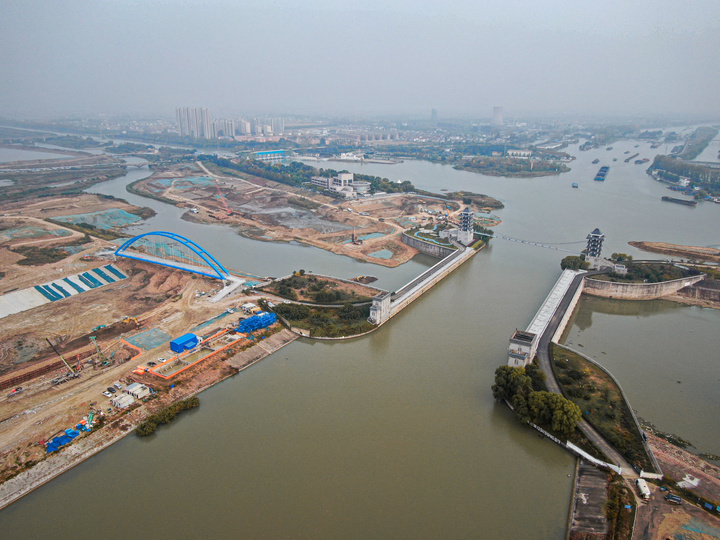
Huai'an Hub of the Phase II Project of the Huaihe River Sea-Entry Channel. Photo by Wang Ruifeng
The Phase II Project of the Huaihe River Sea-Entry Channel is a landmark and strategic project in the Huaihe River Basin flood control system and is of great significance for safeguarding the lives and property of people in the Huaihe River Basin and supporting high-quality economic and social development in the basin. On the basis of the Phase I project, the Phase II project widens and deepens the main channel, raises and reinforces dikes, and expands control hubs, increasing flood discharge capacity from 2,270 cubic meters per second to 7,000 cubic meters per second.
At the construction sites of the Phase II project, machinery roars, vehicles shuttle, and construction workers seize the opportunity and divide labor and cooperate. Everywhere is a busy construction scene. Dai Rongqiang, deputy chief of the comprehensive section of the Yancheng Water Conservancy Project Construction Management Center, told the reporter that after the Phase II project is completed, it will further expand the outlet for Huaihe River floods to the sea, enhance flood control, waterlogging drainage, and disaster reduction capacity across the basin, raise the flood control standard of Hongze Lake from once-in-100-years to once-in-300-years, and while protecting the flood control safety of more than 20 million people and more than 30 million mu of cultivated land in Hongze Lake and downstream areas, also create conditions for shipping development.
The Zhangjiahe Sluice Station is the first dike-crossing structure project to start construction in the Yancheng section of the Phase II Huaihe River Sea-Entry Channel. It has been completed and put into use and fully possesses flood blocking and waterlogging drainage functions. "During this year's flood season, the Zhangjiahe Sluice Station opened its gates for waterlogging drainage 7 times, totaling more than 300 hours and draining more than 60 million cubic meters of waterlogged water, effectively preventing waterlogging in Binhai County caused by heavy rainfall and safeguarding the lives and property of local people," introduced Chen Xiaoxin, chief of the engineering section of the Yancheng Water Conservancy Project Construction Management Center.
The Phase II project attaches great importance to technological innovation. At the Huai'an Hub construction site, the reporter saw that this is no longer simply a scene of roaring machines and busy personnel, but one where digital and intelligent technologies are used to improve construction efficiency and safety.
In the intelligent steel rebar processing center of the Huai'an Hub, multiple fully automated production lines such as the automatic steel rebar seam welding machine production line and the CNC steel rebar bending center are operating in an orderly manner. The steel rebar processing line automatically feeds raw materials, automatically cuts to length, and automatically processes, achieving efficient automated continuous production of semi-finished steel rebars; BIM (Building Information Modeling) can provide realistic three-dimensional display of the construction site, thereby discovering and solving project problems before construction.
The construction site has also incorporated intelligent technological innovation into many details. For example, the smart safety helmet system not only achieves precise positioning of the wearer, but also has functions such as real-time video recording, safety monitoring, real-time conversation, helmet removal alarm, and emergency alarm; the electronic fence separates employee passages from vehicle passages, and realizes separation of people and vehicles through the vehicle intelligent onboard system and the GPS positioning function of smart safety helmets... Construction equipment seems to be endowed with the ability to think, reducing the risk of human error while ensuring quality.
Eliminating flood control hazards, restoring river and lake ecology
In the early winter season, the morning mist has just dispersed. Starting from Maba Town, Xuyi County, and following the recent construction project of the flood detention area around Hongze Lake deep into the lakeside, the reporter saw that the vast shoals are densely covered with aquatic plants, with a few large trees scattered among them. Going further in, wild ducks swim leisurely on the open lake surface, and occasionally water birds fly across the sky.
Gao Zhongguang, technical director of the Xuyi County Water Conservancy Project Construction Management Service Center, told the reporter the origin of the beautiful scenery before him: "With the implementation of a series of engineering measures such as reinforcing dikes and regulating shorelines, the water environment around Hongze Lake has been significantly improved."
The recent construction project of the flood detention area around Hongze Lake is a major national water conservancy project. Its most important task is to eliminate flood control hazards and ensure that it can timely undertake the task of flood diversion and storage when defending against basin-standard floods. Gao Zhongguang introduced that the original lake-facing flood-blocking dike of Hongze Lake had low design standards, a thin and low dike body, and severe erosion by wind and waves. Dike sections with open lake surfaces, long fetch, and facing wind and waves often experienced emergencies, making it difficult to meet the flood storage and detention requirements of "diverting in, storing securely, and releasing out."
"Since the implementation of the project, we have reinforced and raised the lake-facing flood-blocking dike to make every effort to eliminate flood control hazards; at the same time, we have built new dike-crossing culvert sluices, drainage pumping stations, flood inflow and outflow gate openings, and other structures to achieve effective control of flood inflow and outflow in polder areas," Gao Zhongguang said. After the project is completed, it will ensure that the flood detention area around Hongze Lake timely undertakes the task of flood diversion and storage, reduce flood control pressure on Hongze Lake, and ensure the safety of the Hongze Lake dike.
"Next, we will continue to strengthen project construction management, steadily advance project construction progress, make every effort to ensure the flood control safety of the Hongze Lake dike and important downstream cities such as Huai'an, Yangzhou, and Taizhou with more than 18 million people and more than 20 million mu of cultivated land, while continuously improving production and living conditions in the area, further restoring the river and lake ecosystem, and promoting the healthy economic and social development of the flood detention area," Gao Zhongguang said.
The reporter learned from the Provincial Department of Water Resources that, focusing on the annual target, the province is accelerating the implementation of backbone water network projects such as the Phase II Project of the Huaihe River Sea-Entry Channel and the Wusong River (Jiangsu Section) Regulation Project, implementing list-based management and node-based advancement, and ensuring completion of this year's 21 billion yuan construction task for key water conservancy projects on time. It is also planning next year's key water conservancy construction projects in advance, launching the adjustment and construction of the flood discharge area of the Huaihe River main stream below Fushan, making preparations for the follow-up (Phase I) of the Taipu River, emergency management of the Yangtze River dike, and the adjustment and governance of the Lixiahe flood detention polder scope, treating more than 400 kilometers of small and medium-sized rivers and more than 4,000 kilometers of rural ecological rivers, continuing to implement risk elimination and reinforcement of large and medium-sized dangerous sluices and pumping stations, and accelerating the improvement of the water conservancy infrastructure network. It will further sort out and improve reserved projects in the water conservancy field, advance preliminary work for projects to be included in the project library, accelerate approval and project establishment, seize opportunities and actively seek support from government bond funds, and strive to complete more than 60 billion yuan of project reserves in the province by the end of the year.
First Engineering Pile Drilled Smoothly at Nanjing North Station Building Package 1 Project
下一篇Shaanxi Has Completed About 400 Kilometers of Major Water Network Arteries, with the Main Framework of the Water Network Taking Shape at an Accelerated Pace

2026-09-28 1157 0
2026-09-24 10586 0
2026-09-23 10714 0
2026-09-22 10808 0

Lize City Air Terminal Underground Main Structure Nearing Completion: Maximum Transfer Walk Under 4 Minutes After Operation

Anti-seepage Curtain for Main Lock Pit of CSCEC Port Shenqiu Double-Line Lock Project Completed on Schedule

All Pile Foundations Completed on Quanzhou Baiqi Channel

Hainan Upgrades Housing and Municipal Infrastructure
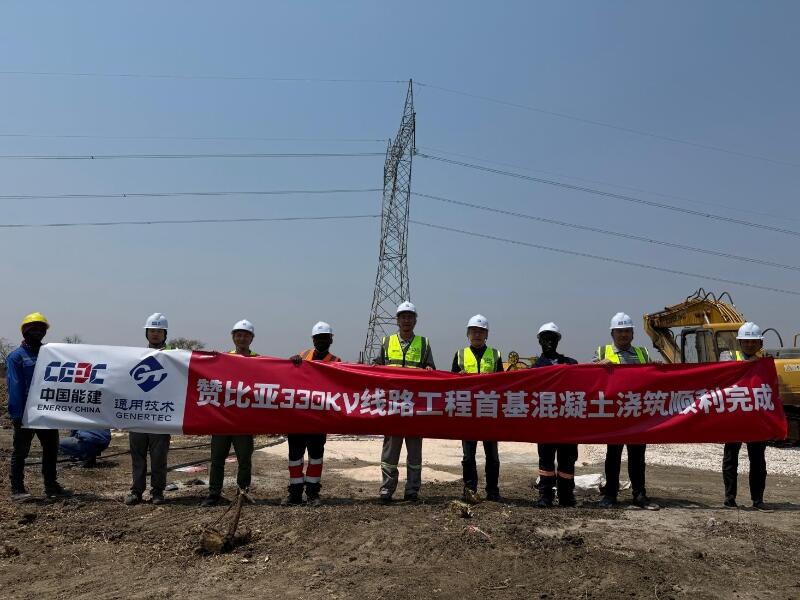
First Foundation Concrete Pour Successfully Completed for Zambia Kafue West–Muzuma 330kV Transmission Line EPC Project
Hot News

评论 (0)