
At 23:29 on the evening of June 16, with the pouring of the last truckload of concrete, all pile foundations of the **main tower pier of the central channel bridge of the Hangzhou Bay Cross-Sea Railway Bridge, constructed with the assistance of Sany rotary drilling rigs, were fully poured.

The 160-meter-class deep bored piles of the central channel bridge of the Hangzhou Bay Cross-Sea Railway Bridge are the deepest bridge bored piles in the world. The geological conditions at the bridge site are extremely complex: not only are there thick, collapse-prone sand layers and silt layers, but hard tuff is also distributed at the pile tips. Although the drill pipe diameter reaches 63 cm, when its length exceeds 150 meters it is like a long, thin "fishing rod," making it extremely difficult to maintain the hole shape and diameter and to drill the bottom rock stratum; once control is improper, there is also the huge risk of hole collapse and drill burial. The completion of all pile foundations of the **main tower pier of the central channel bridge marks substantive progress in the bridge's construction.

It is reported that the completed No. 81 main tower pier has a designed pile diameter of 2.5 meters, a pile length of 129 meters, and a hole depth of 154.5 meters. The bearing stratum at the pile tip is slightly weathered tuff, with the deepest rock penetration reaching 14.24 meters. There are a total of 52 friction bored piles arranged in a plum-blossom pattern, and the designed concrete grade is C40 underwater concrete.

Due to the vast sea area of Hangzhou Bay, strong tides and rapid currents, strong scouring and silting, typhoon disturbances, and other harsh natural conditions, construction organization is extremely difficult and the construction schedule is exceptionally tight. The central channel bridge is entirely offshore construction; all engineering materials, mechanical equipment, and construction personnel must be organized through marine transport, and the complex marine environment further increases the difficulty of construction organization. In addition, the hole formation and pile formation control of 2.5-meter large-diameter ultra-deep bored piles is also quite difficult.

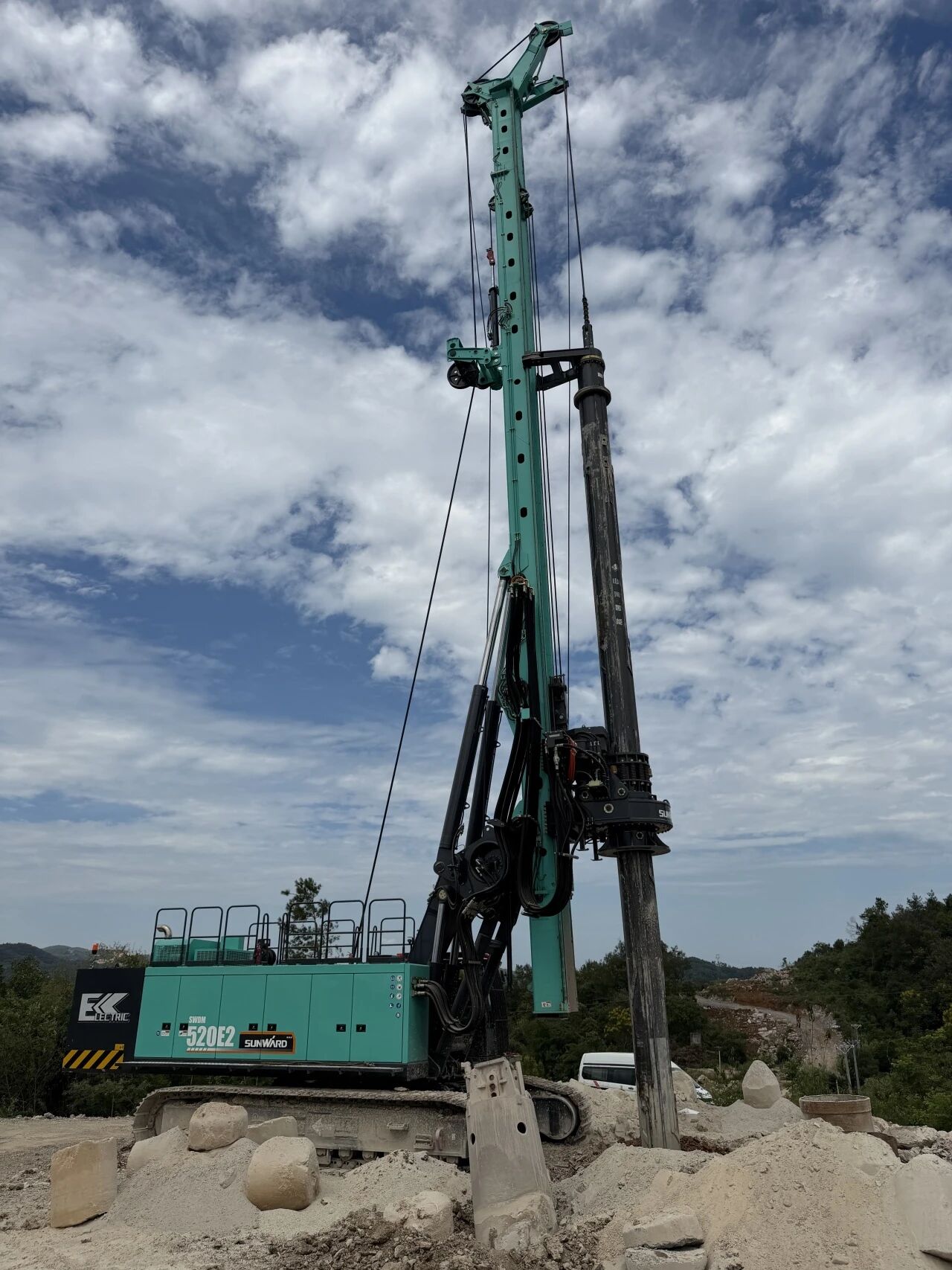
During construction, the project team continuously summarized and explored, and proactively communicated with the client's project department to optimize construction techniques, adopting the hole-forming processes of "800-type rotary drilling + 4000-type rotary drilling" and "800-type rotary drilling + 580-type (520-type) rotary drilling." This fully leveraged the performance advantages of the 800-type rotary drilling rig, raising drilling efficiency to 65-80 hours per hole and greatly shortening the hole-forming cycle, laying a solid foundation for the safe and rapid completion of the bored piles at Pier No. 81.

By continuously adjusting the mud mix ratio, innovating temporary construction structures, and optimizing resource allocation, construction efficiency was significantly improved, gradually rising from 3 days per pile at the beginning to 1 day per pile, with an average efficiency of 1.73 days per pile. The No. 81 main tower pier began drilling on March 18, 2024; over 90 days, the pouring of the last pile foundation was completed on June 16, 20 days ahead of the planned schedule. The pile foundation construction was successfully completed before the typhoon season arrived, seizing the initiative for the subsequent cofferdam construction organization.

Project link
The Nantong-to-Ningbo High-Speed Railway is an important component of the coastal corridor of China's "Eight Vertical and Eight Horizontal" high-speed rail network. Starting from Nantong West Station on the Yancheng-to-Nantong High-Speed Railway, it runs south through Suzhou City in Jiangsu Province and Jiaxing City and Ningbo City in Zhejiang Province, and connects to Ningbo Station in the Ningbo hub. After completion, the project will connect with multiple lines including the already operational Yancheng-to-Nantong High-Speed Railway, Beijing-Shanghai High-Speed Railway, Shanghai-Kunming High-Speed Railway, and Ningbo-Taizhou-Wenzhou High-Speed Railway, as well as multiple lines under construction such as the Jinhua-to-Ningbo Railway and the Shanghai-Nanjing Riverside High-Speed Railway, promoting a more complete road network structure in the Yangtze River Delta region, greatly facilitating travel for people along the line, and being of great significance for advancing high-quality integrated development of the Yangtze River Delta.
Ministry of Housing and Urban-Rural Development Notice on the 2023 Annual Work of Pilot Cities for Intelligent Construction
下一篇Live Preview丨June 19! XCMG's First Electric Double-Wheel Trench Cutter Is Coming — Worth Waiting For

2026-09-28 1137 0
2026-09-24 10491 0

2026-09-23 10629 0
2026-09-22 10708 0

Lize City Air Terminal Underground Main Structure Nearing Completion: Maximum Transfer Walk Under 4 Minutes After Operation

Anti-seepage Curtain for Main Lock Pit of CSCEC Port Shenqiu Double-Line Lock Project Completed on Schedule

All Pile Foundations Completed on Quanzhou Baiqi Channel

Hainan Upgrades Housing and Municipal Infrastructure

First Foundation Concrete Pour Successfully Completed for Zambia Kafue West–Muzuma 330kV Transmission Line EPC Project
Hot News

评论 (0)