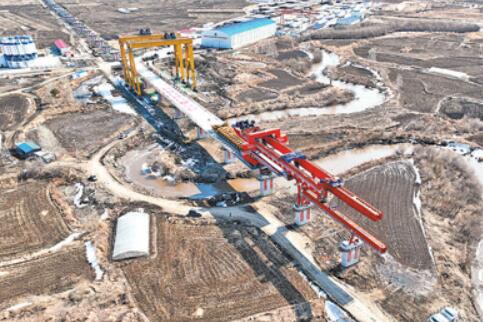

Bridge of Harbin-Yichun High-Speed Railway Harbin-Tieli Section Being Moved Forward into Position for Construction
In recent years, the builders of the Harbin-Yichun High-Speed Railway—China's northernmost high-speed railway currently under construction—have tackled the challenges of permafrost in cold regions, continued to innovate construction techniques, and strictly controlled construction quality. With their hard work and sweat, they have built a solid foundation for the rapidly changing transportation construction in Northeast China, contributing to accelerating the building of a new highland for China's opening-up to the north.
In April in Heilongjiang, under the clear blue sky, the vast and fertile black soil slowly throws off its "quilt," and the pale yellow ice flowers bloom brightly.
The construction site of the Harbin-Yichun High-Speed Railway—China's northernmost high-speed railway currently under construction—is a scene of bustling activity. On the Hulan River, the ice-breakers on the bridge piers are particularly eye-catching; inside the intelligent insulated sheds of the Qing'an girder fabrication yard, girders of bridges solidify and take shape in the steam; beside the Anbang River Grand Bridge, piers stand in rows like bamboo shoots after a spring rain...
Bridge Piers That Can Break Ice——
Optimizing the construction plan, improving device design
"In the same amount of time, 5 kilometers can be built in the south, but here only 1 kilometer can be built. We have to find a way to race against the weather." Braving the cold wind, Ren Guangling, chief engineer of the Harbin-Tieli project of China Railway Construction Bridge Engineering Bureau Group, was busy on the Hulan River Grand Bridge of the Harbin-Yichun High-Speed Railway.
Ren Guangling, 36, is from Liaoning and has participated in many railway engineering projects. But after coming to Heilongjiang, as the person in charge of project quality control, scientific research and innovation, and construction organization, the low temperatures here often gave him headaches. Ren Guangling said: "For the same project, in the south where the temperature is suitable, construction can proceed year-round without interruption, but in Heilongjiang, work cannot start when the temperature is minus 30 degrees Celsius. Watching this makes me anxious."
Ren Guangling led everyone to formulate a construction plan for the early winter period and carried out technical research on the key and difficult points of the project.
The first step was to add construction equipment. Ren Guangling transferred 6 sets of specially made steel sheet piles from Henan, all of which were used on the Hulan River Grand Bridge. This type of pile has high strength and large dimensions and is specially used for bridges in deeper water. "In the south, two sets in rotation can meet the demand for bridge piers, but I used 6 sets working simultaneously, greatly improving operational efficiency," Ren Guangling said.
More importantly, they developed suitable ice-breakers. In early spring, the melting ice floes flow downstream and continuously strike the bridge piers, affecting the service life of the piers and the safety of high-speed railway operations.
Ren Guangling had once seen an ice-breaker made of steel rails at the piers of some large bridges, but because the contact surface was obtuse, the effect was not obvious. He led the technical personnel to communicate with the design unit many times, and finally determined a new form of ice-breaking structure: adjusting the contact surface between the pier and the ice to an acute angle, and using concrete poured integrally with the pier body.
This ice-breaking structure reduces the stressed area, helps divert ice blocks, and reduces damage to the pier from impacts; moreover, it has better integrity, which helps reduce loosening of the ice-breaker and cracking between the ice-breaker and the pier.
Compared with bridge construction, the time for subgrade construction is even tighter: it cannot be done before the spring freeze-thaw period is over, nor can it be done when it rains in summer. "For subgrade construction, we can rearrange the construction sequence. Instead of driving two rows of piles as before, we changed to driving three rows of piles—doesn't that improve efficiency!" Ren Guangling said. "Now, the foundation treatment of the 2.8-kilometer subgrade I am responsible for has been fully completed, and efficiency has doubled."
Ren Guangling spends 8 hours at the construction site every day. In winter and spring, the wind on the 25-meter-high bridge is strong and the temperature is very low. He said: "I can only feel at ease when I keep an eye on the girders on the bridge and the piles under the bridge."
Bridges in the "Greenhouse"——
Building intelligent insulated sheds, innovating parameter calculation methods
"The intelligent insulated shed can automatically adjust the temperature inside, so girder fabrication is not delayed even in winter. This is intelligent tensioning equipment; by entering the formula code, calculation results can be automatically generated to ensure that the bridge stress meets the standard..." In Qing'an County, Heilongjiang, Wang Xiaoyu, technical director of the No. 1 work area of the Harbin-Tieli project of China Railway Construction Bridge Bureau, talked with great enthusiasm about several achievements he had participated in developing.
Wang Xiaoyu, 28, is the youngest work area technical director in the project department. In 2022, he was transferred to the No. 5 bid section project department of the Harbin-Tieli section of the Harbin-Yichun High-Speed Railway, responsible for girder fabrication and erection for the Anbang River Grand Bridge. Reinforced concrete is used to make bridges, but in Heilongjiang's severe cold weather, concrete solidification becomes a major problem.
"Solidification and freezing are two different concepts. Cold air may appear to freeze the concrete solid, but once the temperature rises it may turn into waste residue, so the working environment must be kept above 10 degrees Celsius." Wang Xiaoyu explained that he drew inspiration from vegetable greenhouses and led everyone to build 16 insulated sheds with insulation boards for girder fabrication. They also installed intelligent temperature controllers in the sheds, keeping the temperature inside always above 10 degrees Celsius. "Even if it is minus 20 degrees Celsius outside, one bridge girder can be produced in the shed every day," Wang Xiaoyu said.
Fabricating girders in the shed involves multiple processes such as placing reinforcement into molds, mixing concrete, pouring concrete, prestressing construction, moving girders within the yard to the steam-curing shed, and curing. Compared with normal construction, there are three additional processes: formwork preheating, steam curing, and covering with quilts. "Heating and insulation are very important," Wang Xiaoyu said.
"If a bridge is loose and slack, it will collapse when compressed, so it needs to be tensioned in advance; then its crack resistance and load-bearing capacity improve—this is prestressing." Wang Xiaoyu said that the tensioning work requires a prestressed tensioning machine. In the past, 16 to 21 data values had to be calculated manually in advance and then the parameters entered into the equipment, which was not only very complicated but also risked errors. Wang Xiaoyu participated in innovating the calculation formulas for prestress and elongation values, so that the required values can be calculated quickly and accurately with just one computer. Ultimately, the dimensional error of the bridge girders they produced did not exceed 20 millimeters, and the strength was not less than 50 megapascals.
After the girders are made, another challenge is erection. After the girder is lowered onto the bearing pad on the pier, grouting material is needed to ensure firm erection. "Based on past experience and multiple water temperature tests, we finally used 40-degree Celsius warm water with early-strength grouting material—that is, cement that sets faster—stirred and then used for grouting, and then covered with insulation blankets and quilts to keep warm until the design strength is reached," Wang Xiaoyu said.
"Within my area of responsibility, a total of 369 bridge girders are needed. At present, 72 have been built, and it is expected to be completed by the end of October this year," Wang Xiaoyu said with confidence.
Bridge Piles Under Permafrost——
Breaking frozen soil with a hydraulic breaker, precisely placing casings
"Dong! Dong! Dong!" Not long ago, by the Anbang River, a hydraulic breaker originally used for crushing concrete took on a new job here. "Previously, an excavator was used to dig frozen soil, and it took 7 hours to drive one pile. Now we first use the breaker to smash it, then dig the pit, and it can be completed in 4 hours." Qiao Shuxun, general manager of the Fourth Company of China Railway Construction Bridge Bureau and commander of the bid section project, said that this method was thanks to bridge engineer Zhao Yuxiang.
The Anbang River Grand Bridge is 22.12 kilometers long and has more than 5,400 pile foundations, and the pile locations are all in rice fields. Once winter comes, the soil and water in the rice fields freeze together like a hard shell, and a shovel of the excavator leaves only a large white spot.
Construction must also comply with the Black Soil Protection Law. "We need to strip and protect the 50-centimeter-thick topsoil of black soil within the land-use red line and within the construction access roads, for farmland reclamation after completion," Zhao Yuxiang said. The frozen soil layer is hard and difficult to strip, all of which requires a sharp tool that can break open the frozen soil.
"After breaking open the frozen soil, the next step is to place steel casings used for positioning the bridge piles, and wall-protecting mud slurry must be poured into the casings," Zhao Yuxiang said. When grouting in frozen soil, first, circulation is needed to prevent the slurry from freezing; second, insulation is needed, using slurry above 10 degrees Celsius.
This brings another risk: the heat of the slurry is conducted through the casing to the frozen soil outside, causing the frozen soil to thaw, and the casing is then prone to deviation. This requires surveyors to promptly detect the casing position and make adjustments. If adjustment cannot be made at the original casing position, the casing must be pulled out and repositioned and buried again.
Zhao Yuxiang also has high requirements for the concrete used to pour the bridge piles. "We use hot-air guns to heat the sand and crushed stone in the concrete, then mix it with 50-degree Celsius warm water to ensure its temperature reaches above 10 degrees Celsius. During transportation, we also wrap the tank body tightly with quilts and insulation cotton."
"Now more than 5,000 of the more than 5,400 bridge piles have been completed, and all will certainly be completed next month," Zhao Yuxiang said.
On the road, Zhao Yuxiang encountered a group of workers gathered around a bridge pier, occasionally voicing admiration. Approaching, it turned out that a cluster of pale yellow ice flowers had aroused everyone's interest.
Ice flowers often break through the ice when it is covered with snow and ice—are the builders not like ice flowers too? Flowers do not fear ice and snow and are born by breaking the ice; people do not fear severe cold and build bridges and roads.
Further Reading
How Are High-Speed Railways Built in Severe Cold Regions?
The Harbin-Yichun High-Speed Railway is the high-speed railway under construction at the highest latitude in China, with the largest annual temperature difference across the entire line, and the first high-speed railway to cross a multi-year island permafrost area. It starts in Harbin City, Heilongjiang Province, and ends in Yichun City, with a main line length of 318 kilometers and a design speed of 250 kilometers per hour. Construction started in October 2021, and the entire line is expected to open to traffic in October 2026.
The Harbin-Yichun High-Speed Railway is located in a severe cold region, with a complex geological structure and multiple seasonal frozen soil areas. The entire line is covered by black soil, and it also crosses some primeval forests and secondary water source protection areas, among others, so construction requirements are high and difficult. In the face of severe cold and low temperatures, a heating and insulation construction method for girder fabrication and erection in the early winter period is adopted; for pile burial in frozen soil, an innovative construction method of burying piles after breaking the frozen soil with a hydraulic breaker is used; to meet environmental protection requirements, construction requirements such as stripping 50 centimeters of topsoil black soil for reclamation are formulated; to cope with spring ice impacts on bridge piers, an integrated acute-angle concrete ice-breaking structure has been improved and produced... At present, the project construction is progressing steadily as planned. After the entire Harbin-Yichun High-Speed Railway is completed and opened to traffic, it will continuously meet the travel needs of the general public and contribute to accelerating the building of a new highland for China's opening-up to the north.
Bihu Bridge Reconstruction and Expansion Project to Complete Bridge Construction by End of 2025
下一篇Builders of the Harbin-Yichun High-Speed Railway Continue to Innovate: How China's Northernmost High-Speed Railway Overcomes Permafrost Challenges

2026-10-18 0 0

2026-10-18 0 0

2026-10-17 0 0

2026-09-23 10598 0
Lize City Air Terminal Underground Main Structure Nearing Completion: Maximum Transfer Walk Under 4 Minutes After Operation
Anti-seepage Curtain for Main Lock Pit of CSCEC Port Shenqiu Double-Line Lock Project Completed on Schedule
All Pile Foundations Completed on Quanzhou Baiqi Channel

Hainan Upgrades Housing and Municipal Infrastructure
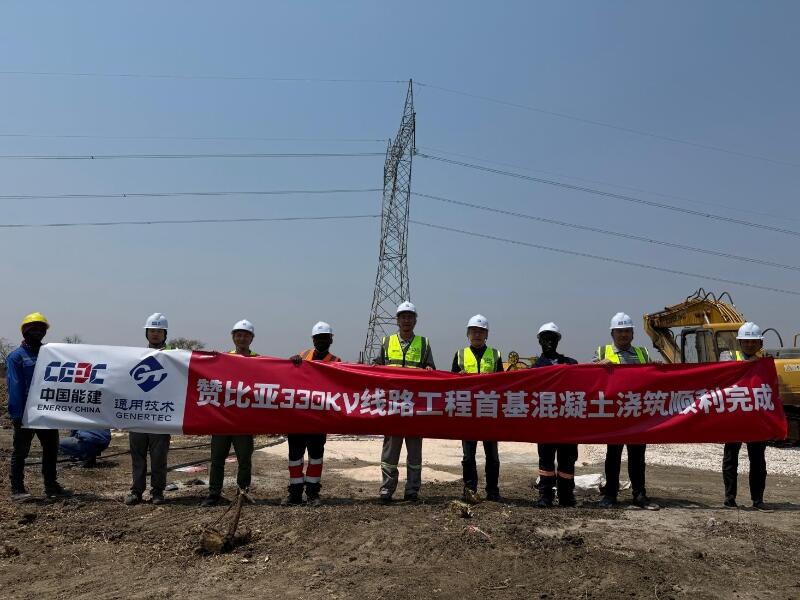
First Foundation Concrete Pour Successfully Completed for Zambia Kafue West–Muzuma 330kV Transmission Line EPC Project
Hot News

评论 (0)