Wuhan Metro Line 12 is a cross-river metro line. When digging the river-crossing tunnel, what exactly was dug up from the riverbed, how was it brought ashore, and where did it go? On the 11th, reporters went directly to the Wuhan Metro Line 12 construction site to find the answers.
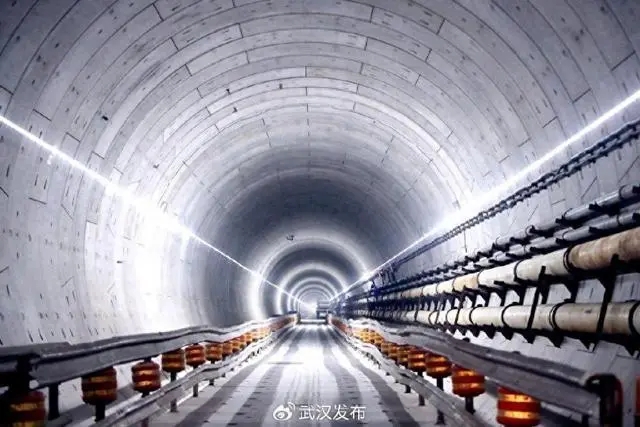
The formed tunnel of the Lingwucun Station — South Guobo Center Station section of the Wuhan Metro Line 12 river-crossing tunnel. Photo by Correspondent Yuan Yonghua
Encountering a sticky "rice-cake ball"
The shield machine switched to ram-horn-shaped cutters
On the 11th, 40 meters underground, after 10 hours of construction, good news came from the front of the Ling-Guo section: 4 cutters had been successfully replaced on the super-large shield machine "Jiangcheng Pioneer".
To do a good job, one must first sharpen one's tools. "Jiangcheng Pioneer" is the key to tunneling under the riverbed.
The Wuhan Metro Line 12 river-crossing tunnel starts from South Guobo Center Station in Hanyang District, crosses the Yangtze River, and will reach Lingwucun Station in Hongshan District, with a total length of 3.37 kilometers. The Ling-Guo section is one of the two Yangtze River-crossing tunnels of the metro loop line 12. In May 2022, the super-large shield machine "Jiangcheng Pioneer" was launched from South Guobo Center Station.
"Seventy percent of the tunnel in the Ling-Guo section is underwater. Shield tunneling under the riverbed is most afraid of encountering highly viscous mudstone strata," introduced Wang Bin, a Level-2 project manager of Wuhan Metro. According to surveys, the Ling-Guo section has about 800 meters of full-face mudstone strata. These mudstones are like rice-cake balls and easily clog the cutterhead, preventing the shield machine from advancing normally.
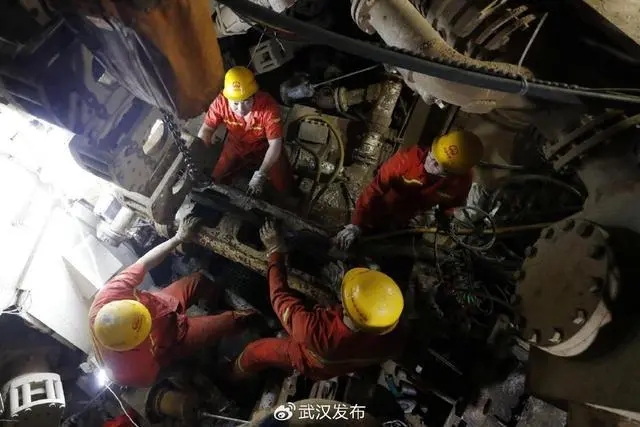
Workers replacing worn cutters on the shield machine. Photo by Correspondent Yuan Yonghua
The "Jiangcheng Pioneer" responsible for this tunneling is custom-made, with an excavation diameter of 12.56 meters, equivalent to the height of a 4-story building. It can handle the "rice-cake ball" that is "hard in its original state and becomes sticky when exposed to water," but not easily.
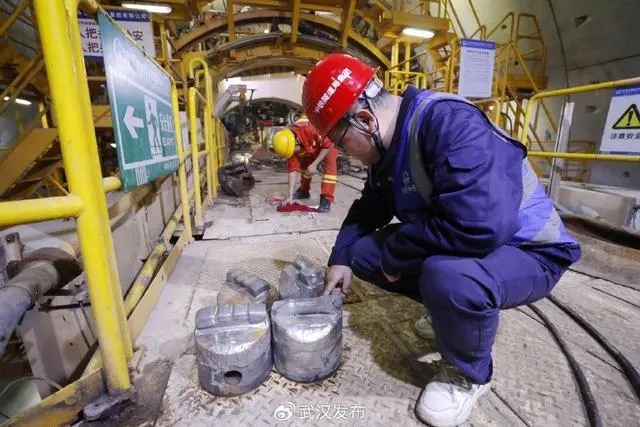
Regarding the mudstone, Wu Lei, deputy chief engineer of the project of the contractor China Railway Tunnel Group, introduced that before launch, the shield cutterhead had already been improved by increasing the opening ratio of the cutterhead. But when tunneling reached 800 meters, it was found that the more than 100-kilogram "gage cutters" on the outer ring of the shield machine were severely worn.
To solve this problem, the project department immediately decided to change the cutters to a ram-horn shape. This kind of cutter is like the plow used for farming in rural areas; the mudstone it cuts off is larger in volume and less likely to soften and clog the cutterhead.
With the optimized cutters, the shield machine's tunneling speed reached 9.6 meters per day. This speed is 8 times that of traditional cutters.
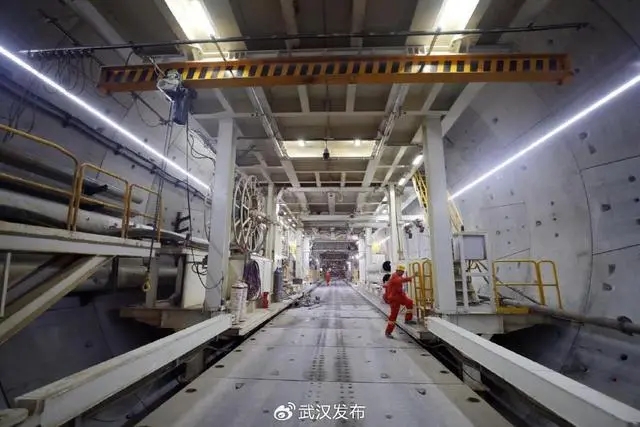
The "Jiangcheng Pioneer" shield machine responsible for the river-crossing tunneling of the Ling-Guo section of Line 12. Photo by Correspondent Yuan Yonghua
When big stones come, they cannot get out
"Heart bypass" with an auxiliary pipe
Besides mudstone, there were also stones. When the shield machine had tunneled to 1,000 meters, it encountered many large stones ahead. The output of the stones became a problem.
Inside the tunnel, reporters saw two pipes with a diameter of 50 centimeters running all the way from the portal to the shield machine. They are like the blood vessels of the shield machine: one is responsible for transporting the muck generated during tunneling out of the tunnel, and the other is responsible for delivering fresh slurry to the shield machine inside the tunnel.
If the stones are too large in diameter, pipe blockage is inevitable. To prevent stones from blocking the pipes, the shield machine could only stop and remove the stones manually, which greatly reduced work efficiency.
Workers inspecting worn cutters on the shield machine during tunneling. Photo by Correspondent Yuan Yonghua
For this reason, the project department came up with a "heart bypass" approach: installing an auxiliary pipe on one side of the main pipe. Once the main pipe suffered an "intestinal obstruction," the auxiliary pipe would take over the transport.
One problem was solved and another appeared. When the shield machine had tunneled to 1,200 meters, there were more and more stones with a diameter of about 30 centimeters. The pipe transporting muck outward was blocked 22 times, and the auxiliary pipe alone could not fully solve the problem.
"Later we installed grates to retain the large stones, which entered a stone-collection box and were crushed into stones below 20 centimeters in diameter before being transported out," said Shi Yuan, project manager of the contractor China Railway Tunnel Group.
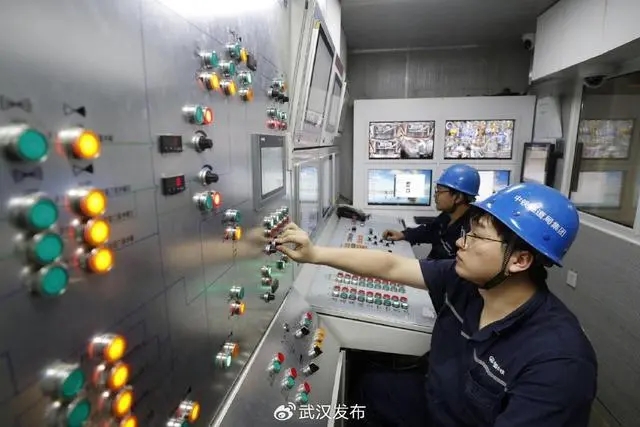
Workers operating the "Jiangcheng Pioneer" shield machine for tunneling. Photo by Correspondent Yuan Yonghua
Mudstone brought ashore undergoes "dry-wet separation"
Slurry can also be recycled
To date, Wuhan Metro has completed a total of 4 Yangtze River-crossing lines, namely Line 2, Line 4, Line 7, and Line 8. The earliest completed Line 2 has been in safe operation for 12 years.
"It is quite difficult for a shield machine to tunnel under the riverbed," introduced Zhang Ning, a senior engineer of Wuhan Metro Co., Ltd. Beneath the sand layer of the Yangtze River bed in the Wuhan section are distributed mudstone and conglomerate, with the conglomerate mainly argillaceous cementation. The matrix of the mudstone and conglomerate has a high content of clay minerals and is extremely viscous, making it very easy to form mud cakes on the shield cutterhead and causing poor muck discharge by the shield machine. Moreover, the gravel in the conglomerate is mainly composed of quartzite and limestone, with very high hardness and a maximum particle size of up to 20 centimeters. These reduce the construction efficiency of the shield machine and cause severe cutter wear. "Therefore, for every shield construction, we adapt to local conditions and choose the most suitable construction method according to different geological survey conditions."
Where did the mudstone and stones brought ashore go? The on-site person in charge introduced that the mudstone transported out of the tunnel would be sent to separation equipment for muck separation. The separated slurry would be recycled, while the dry muck and stones would be transported to disposal sites and handled according to regulations.
Up to now, the 3.37-kilometer river-crossing tunnel Ling-Guo section of Wuhan Metro Line 12 has successfully overcome two major technical difficulties and has smoothly tunneled 3.23 kilometers. It is expected to break through in May this year. Only the last 140 meters of tunneling remain, and reporters will continue to follow up.



评论 (0)