
Bailey Rack For Sale Company Shenzhen Bailey Rack Shandong Taiheng Bailey Panel
商品详情
Product Details
How should the Bailey bridge diamond jack be used?
I don't know how much everyone knows about Bailey bridges. The editor has recently learned some small knowledge about Bailey bridges. Bailey bridges are widely used in the construction industry. The Bailey bridge diamond jack is used at the same time. Many people may not know much about Bailey bridge jacks. Today we will take a look at how Bailey bridge jacks should be used.

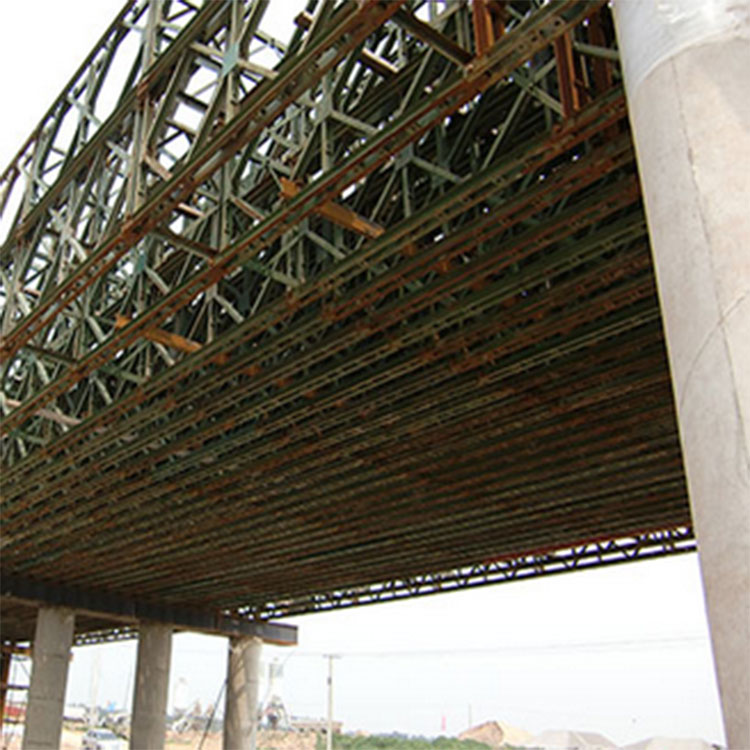
Bailey bridge diamond jack: It is a diamond-shaped frame connected by steel pins at four corners. A jack screw is inserted horizontally through one diagonal; depending on the direction of rotation of the jack screw, the diamond frame can be opened or closed. At both ends of the other diagonal, concave positioning brackets are installed so that the diamond jack can sit on the truss chord. As the jack opens or closes, the truss can be pushed or pulled, facilitating assembly under special circumstances. Chord jacks are used only when installing the upper truss. After one layer of the bridge is installed, due to the self-weight of the structure and the clearance between pins and pin holes, downward bending or upward arching will occur, causing the joints to be misaligned when installing the upper truss. At this time, the chord jack must be used to push or pull the upper truss into position before the pins can be inserted. The Bailey bridge connection system includes diagonal braces, connecting plates, support frames, wind-resistant tie rods, etc. Diagonal braces are used to increase the lateral stability of the bridge. Each end has a hollow conical sleeve; one end is connected to the support frame hole on the vertical end post of the truss, and the other end is connected to the short column of the crossbeam. Each truss section is equipped with a pair of diagonal braces on the end vertical posts, and an additional pair is added at the bridgehead end posts. The diagonal braces are connected to the truss and crossbeam with diagonal brace bolts. Chord jack: composed of three parts: diamond jack, seat frame, and female head pad.

1. When the Bailey bridge sags downward and it is desired to install the second layer of trusses, the upper pin holes of the front and rear trusses can be aligned without difficulty and pins inserted; however, the lower pin holes of the trusses will inevitably be misaligned due to the sagging of the upper chord of the lower bridge, and external force is required to align them. At this time, use truss bolts to fix (without tightening) one of the trusses, place the seat frame on the upper chord of the lower bridge behind the other truss, and connect the seat frame to the lower truss with bolts passing through the bolt holes in its head; place the diamond jack between the seat frame and the truss, and use a wrench to turn the jack screw (if necessary, insert a steel pipe over the wrench handle to increase the turning radius and reduce the turning force), so that the diamond jack gradually opens from its originally closed position; at this time, one end of the jack presses against the seat frame, and the other end pushes the truss, causing the misaligned adjacent pin holes at the lower part to slowly come together until they are aligned, and then insert the pins. If the pushed end of the truss is a female head, set up a female head pad, and the diamond jack presses against the pad.


What are the advantages of Bailey panels?
The editor brings you good news: a new type of Bailey panel has recently been introduced. Because of its high accuracy, let's take a look at its features.
Many new product manufacturing materials that have appeared in recent years can resist the thermal effects generated during processing. However, cutting with a water jet ensures that the material structure remains unchanged; moreover, Shenzhen Bailey rack, Bailey panel technology can be applied to various materials that are not water-soluble. Reliable production processes can produce complex shapes with processing widths as narrow as 20 microns. The machine uses a high-precision water jet with a diameter of less than 300 microns, and the material cutting speed can reach 4000 mm per minute. These servo systems with high power density for Bailey panels can greatly reduce the control cabinet's