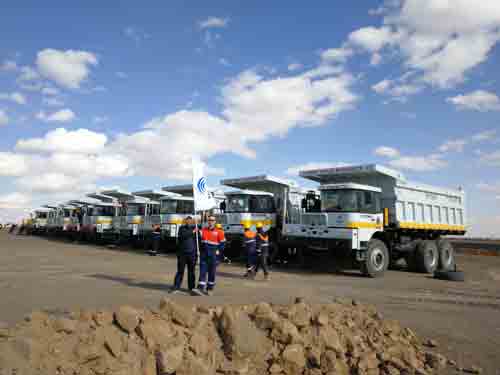
Maintenance and Servicing of Air Conditioning for Mining Vehicles in Summer (Part 1)
商品详情
Maintenance and Servicing of Air Conditioning for Mining Vehicles in Summer (Part 1)
Automotive air conditioning uses evaporative cooling for refrigeration, that is, it utilizes the principle that a refrigerant with a very low boiling point absorbs heat from the surrounding air during vaporization, thereby transferring the heat from the air in the cab to the refrigerant, which is ultimately carried to the outside atmosphere, achieving the purpose of cooling the cab.
Working principle of the air conditioning system: The compressor is driven by the engine via a belt, and the electromagnetic clutch of the compressor is controlled through the control panel, causing the compressor to engage and start working. The high-temperature, high-pressure gas coming out of the compressor is sent through a high-pressure hose to the condenser for cooling. After cooling, the refrigerant becomes a high-temperature, high-pressure liquid that flows from the bottom of the condenser to the receiver-drier. After filtration and dehydration, it passes through a high-pressure hose to the expansion valve. The expansion valve performs a throttling and expansion function. After passing through the expansion valve, the refrigerant becomes a low-temperature, low-pressure mist that boils inside the evaporator, absorbing a large amount of heat from the walls of the evaporator core tubes and vaporizing into gas. At the same time, the blower continuously draws hot air from inside the vehicle and passes it over the evaporator; after being cooled, the air is returned to the vehicle, completing the mission of cooling the interior. The low-temperature, low-pressure superheated gas coming out of the evaporator is drawn in by the compressor and compressed into high-temperature, high-pressure gas for reuse. This completes a refrigeration cycle.